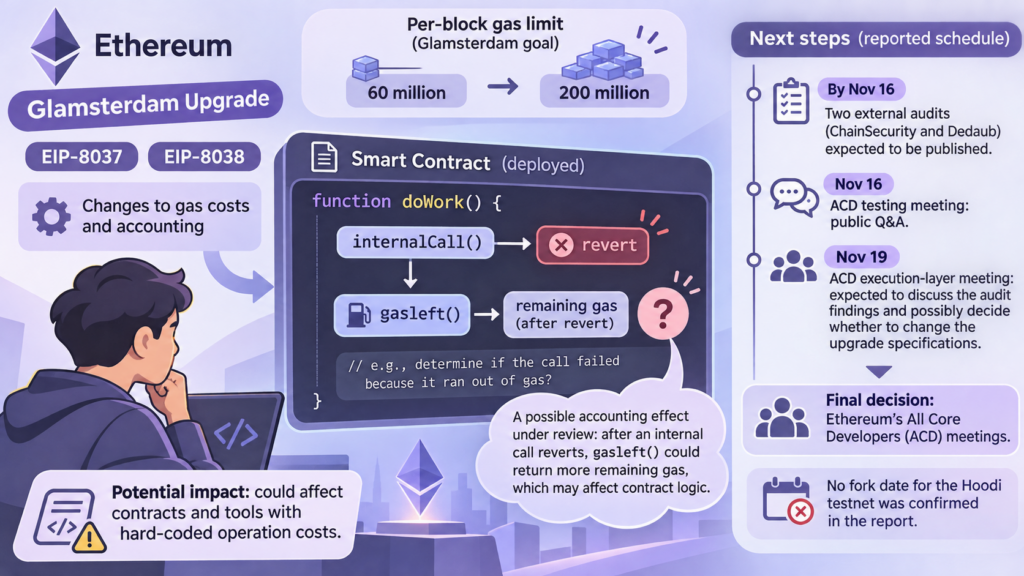
For builders with deployed contracts, the question is whether Glamsterdam’s proposed gas changes could alter behavior their code relies on. As reported by Foresight News on November 10, 2026, Ethlabs said EIP-8037 and EIP-8038 involve changes to gas costs and accounting that could affect some deployed smart contracts.
Ethlabs recommended waiting until external audit results are published and the effects are clearer before changing the upgrade specifications or setting a fork date for the Hoodi testnet. The final decision rests with Ethereum’s All Core Developers (ACD) meetings; no fork date was confirmed in the report.
Two external audits commissioned by the Ethereum Foundation, from ChainSecurity and Dedaub, were expected by November 16. A public Q&A at an ACD testing meeting was scheduled for the same day. An ACD execution-layer meeting on November 19 was expected to discuss the findings and might decide whether to change the upgrade specifications.
Glamsterdam aims to raise Ethereum’s per-block gas limit from 60 million to 200 million. Ethlabs warned that changed gas costs could affect contracts and tools with hard-coded operation costs. It also described a possible accounting effect: after an internal call reverts, gasleft() could return more remaining gas, potentially affecting how a contract determines whether the call failed because it ran out of gas. These were potential effects under review, not confirmed behavior across deployed contracts.
Source: foresightnews.pro (originally published 2026-11-10 17:44 UTC+8)