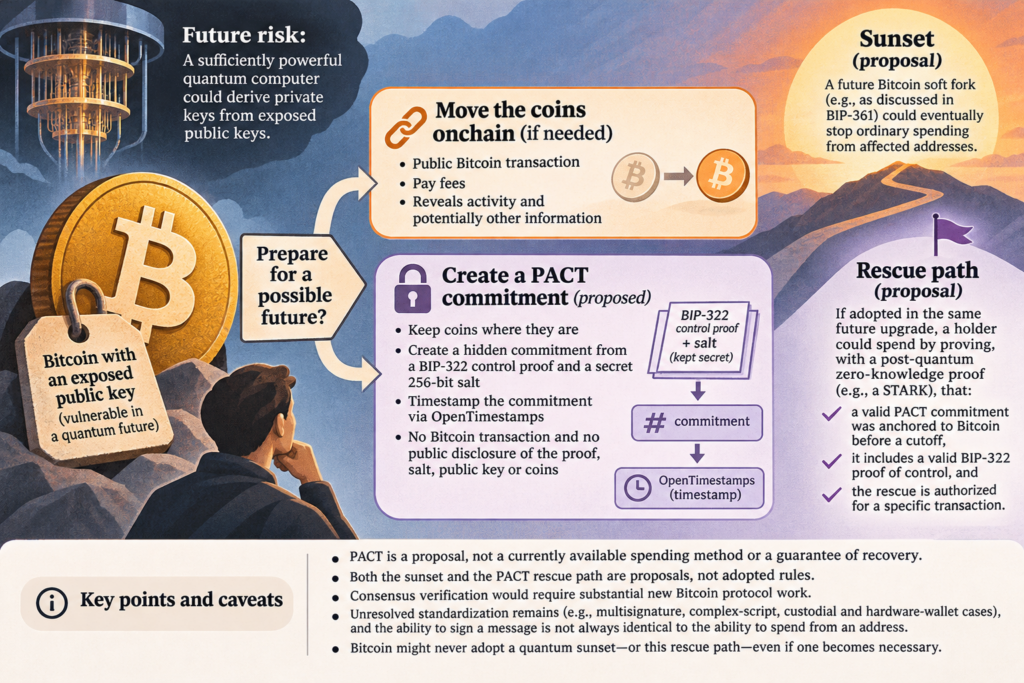
For a Bitcoin holder with an exposed public key, preparing for a future quantum threat could mean moving coins publicly. A Paradigm article published on May 1, 2026 proposes another way to preserve evidence of control without moving them now. It calls the proposed method a Provable Address-Control Timestamp, or PACT.
Why a timestamp might matter
A sufficiently powerful cryptographically relevant quantum computer could, in the scenario described by the article, derive private keys from exposed public keys. One proposed response, discussed in the draft of BIP-361, is a future Bitcoin soft fork that would eventually stop ordinary spending from affected addresses. No such sunset or PACT rescue rule is presented as adopted.
A sunset would create a difficult choice for dormant holders: move coins before a cutoff, paying fees and revealing activity onchain, or risk losing access. The article estimates that wallets believed to belong to Satoshi Nakamoto held around 1.1 million BTC, worth more than $75 billion at the time of its reporting. Those early coins illustrate a limitation of rescue approaches based on BIP-32 parent keys: older keys may not have been derived that way.
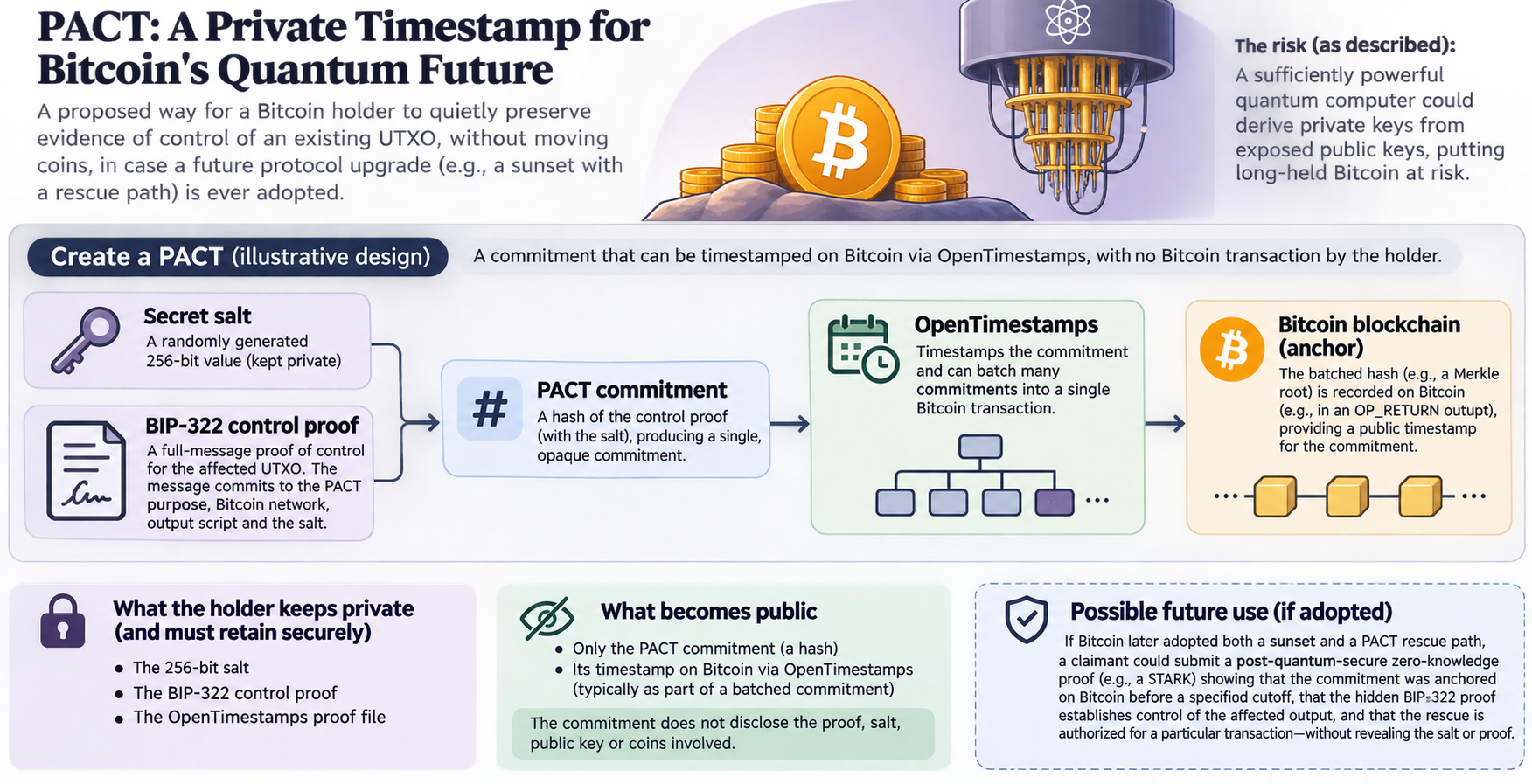
How the proposed commitment works
In the article’s illustrative design, a holder creates a secret 256-bit salt and a BIP-322 full-message proof of control for the affected unspent transaction output (UTXO). The message identifies the PACT purpose, Bitcoin network, output script and salt. The holder hashes the proof with the salt into a commitment, then timestamps that commitment through OpenTimestamps, which can batch hashes into a Bitcoin transaction.
The holder makes no Bitcoin transaction to create the commitment. The timestamp does not disclose the proof, salt, public key or coins involved, though the article cautions that network metadata still needs protection. The holder must securely retain the salt, control proof and OpenTimestamps proof file.
If Bitcoin later adopted both a sunset and a PACT rescue path, a claimant could submit a post-quantum-secure zero-knowledge proof, such as a STARK, showing that the commitment was anchored to Bitcoin before a specified cutoff, that the hidden BIP-322 proof establishes control of the affected output, and that the rescue is authorized for a particular transaction. The hidden salt and control proof would not need to be published.
This is a proposal, not a currently available spending method or a guarantee of recovery. The article says consensus verification would require substantial new Bitcoin protocol work. It also notes unresolved standardization for multisignature, complex-script, custodial and hardware-wallet cases, and cautions that the ability to sign a message is not always identical to the ability to spend from an address. Bitcoin might never adopt a quantum sunset—or this rescue path—even if one becomes necessary.
Source: paradigm.xyz (originally published 2026-05-01 22:54 UTC+8)