For builders working on private receipt of funds, the proposed engineering work centers on how a wallet registers its keys, derives a stealth address and signs a transaction. In a report published on November 18, 2026, at 21:30 UTC+8, Pierre, described as a privacy researcher associated with the Ethereum Foundation’s ecosystem portal, announced a Stealth Addresses working group focused on ERC-5564 and hardware-wallet integration.
According to the report, the group includes the Ethereum Foundation, ScopeLift—the team behind Umbra—stealth-address wallet Fluidkey and hardware-wallet maker Trezor. It plans to meet every two weeks. Its stated work remains a roadmap, not a set of completed deployments or adopted standards.
The group proposes a hybrid approach combining existing elliptic-curve cryptography with ML-KEM, a lattice-based key-encapsulation mechanism, for a future update to ERC-5564. The report presents this as a way to address the risk of future quantum computers being used to trace historical transfers. It also says the group is working on a separate production-grade reference implementation; the report describes two independent implementations and a system-level audit as prerequisites for moving ERC-5564 toward Final status.
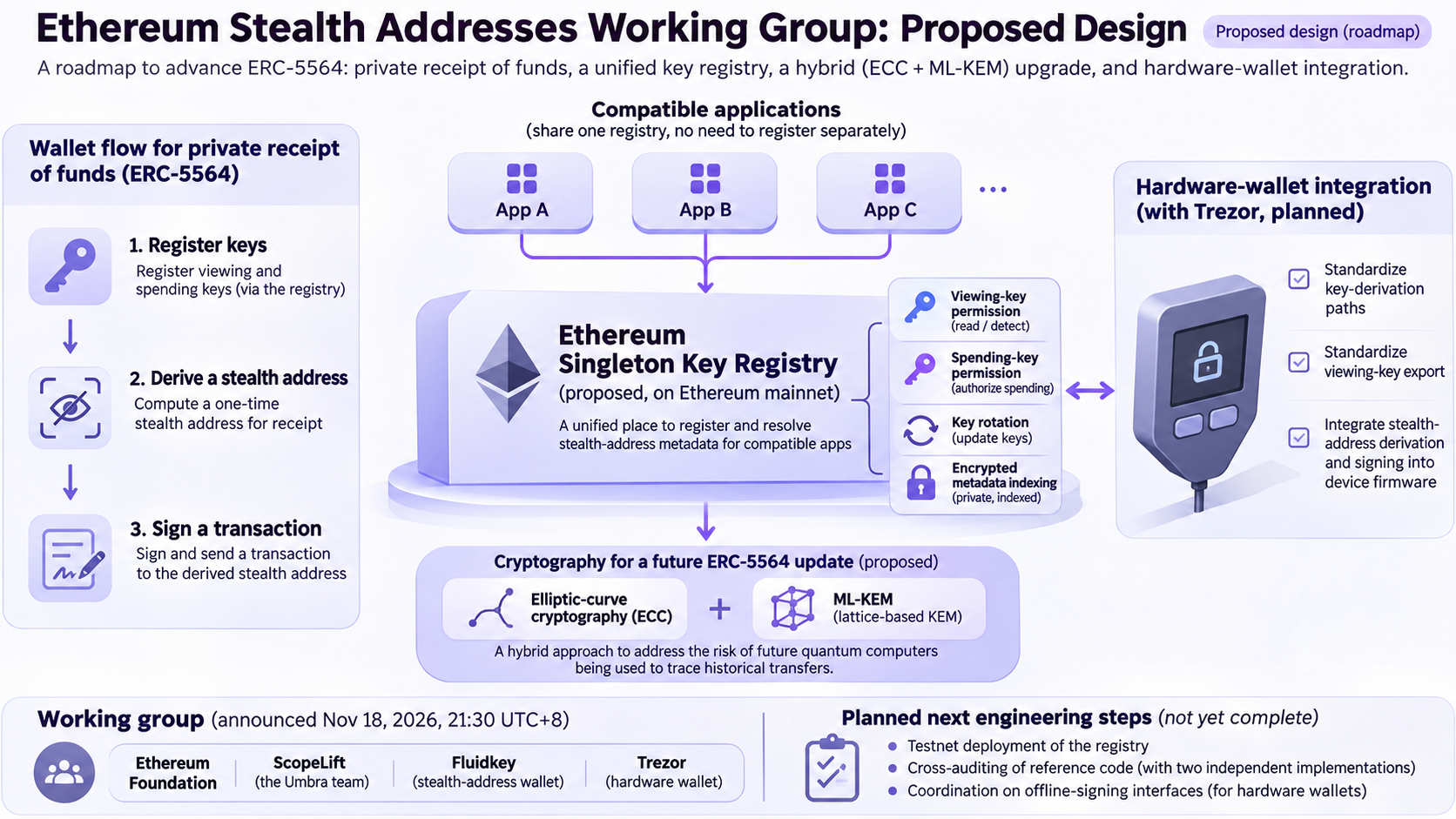
For applications, the group plans a singleton key registry contract on Ethereum mainnet. Its intended purpose is to give compatible applications one place to register and resolve stealth-address metadata, rather than requiring a user to publish it separately in each app. The proposed design separates spending-key and viewing-key permissions and provides for key rotation and encrypted metadata indexing. The report does not say the mainnet contract has been deployed.
The hardware-wallet work with Trezor is likewise prospective. The group plans to standardize key-derivation paths and viewing-key export, and to integrate stealth-address derivation and signing into device firmware. The report lists testnet deployment of the registry, cross-auditing of reference code and coordination on offline-signing interfaces among the next engineering steps; it does not report that those steps are complete.