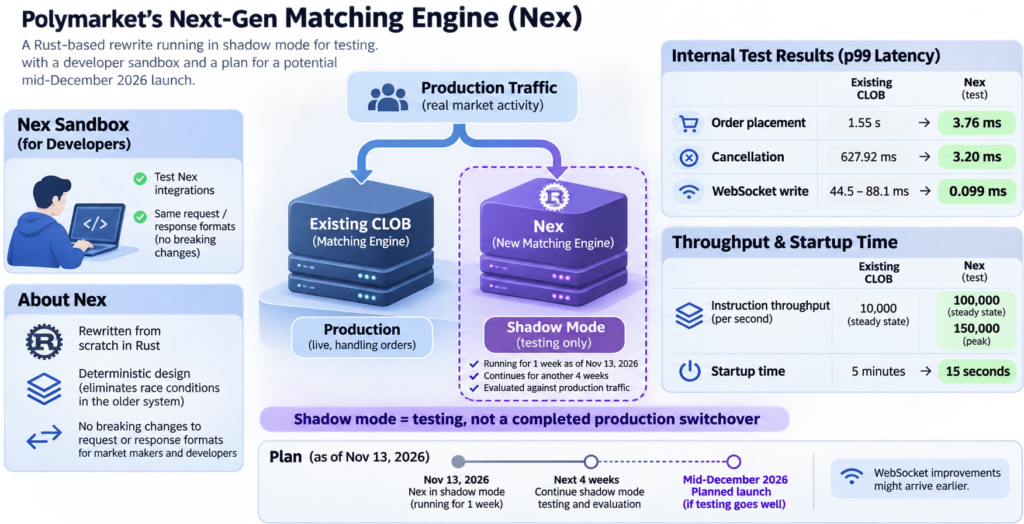
Developers testing Polymarket integrations can use a Nex sandbox, while the exchange evaluates its rewritten matching engine against production traffic. In a report published on November 13, 2026, Polymarket VP of Engineering Josh Stevens said Nex had been running in shadow mode for one week and was not yet scheduled to replace the existing engine.
According to Stevens, internal tests measured a drop in p99 order-placement latency—the time within which 99% of measured orders completed—from 1.55 seconds to 3.76 milliseconds. Cancellation latency fell from 627.92 milliseconds to 3.20 milliseconds, while p99 WebSocket write latency fell from a range of 44.5–88.1 milliseconds to 0.099 milliseconds.
Stevens said the existing central limit order book (CLOB) handles 10,000 instructions per second in a steady state, compared with 100,000 for Nex and a peak of 150,000. He also reported a reduction in startup time from five minutes to 15 seconds. Nex was rewritten from scratch in Rust; Stevens said its deterministic design eliminates race conditions present in the older system and does not introduce breaking changes to request or response formats for market makers and developers.
As of the November 13 report, the plan was to keep Nex in shadow mode for another four weeks and, if testing went well, launch it in mid-December 2026. Stevens said the WebSocket improvements might arrive earlier. These were reported test results and plans, not confirmation of a production launch.