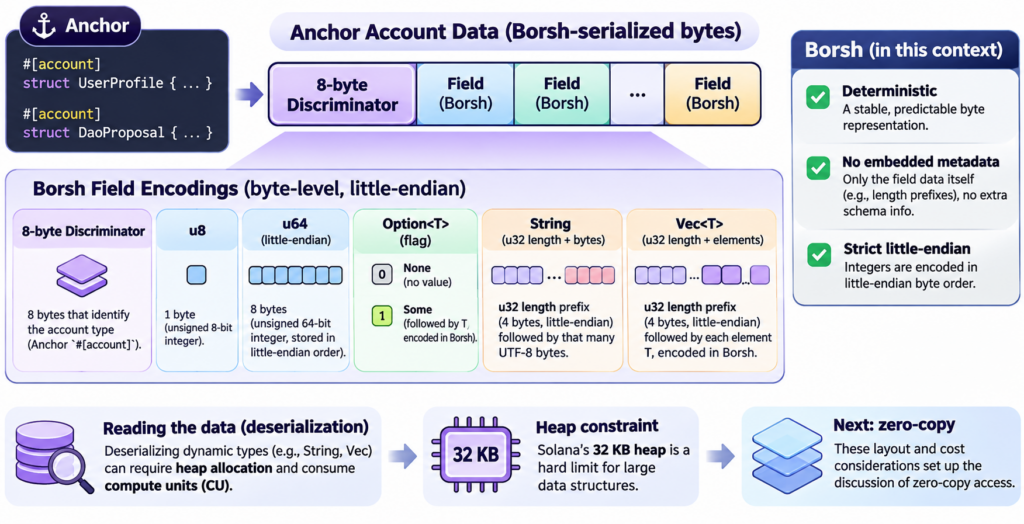
When inspecting data stored by an Anchor #[account] type, the builder’s task is to understand how its fields become bytes—and what it costs to read them back. An article published on November 16, 2026, explains this through UserProfile and DaoProposal examples.
The account layout begins with an 8-byte discriminator. The examples then break down Borsh-serialized fields byte by byte: u8 and u64 integers, a flag indicating whether an Option contains a value, and String and Vec values whose lengths are prefixed by a u32. The article describes Borsh as deterministic, without embedded metadata, and strict about little-endian byte order.
Those layout rules also matter when a program reads the data. The article notes that deserializing dynamic types can require heap allocation and consume compute units (CU). It identifies Solana’s 32 KB heap as a hard constraint for large data structures, setting up its subsequent discussion of zero-copy access.