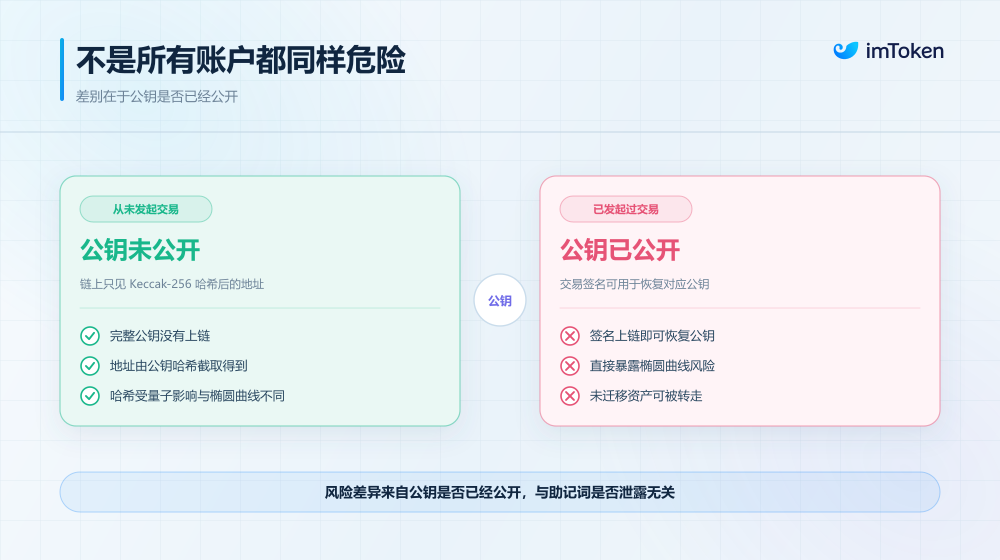
For wallet developers, the hardest part of a post-quantum upgrade may not be generating a new key. It may be giving that key control of an existing account without losing access to the assets and applications tied to its address.
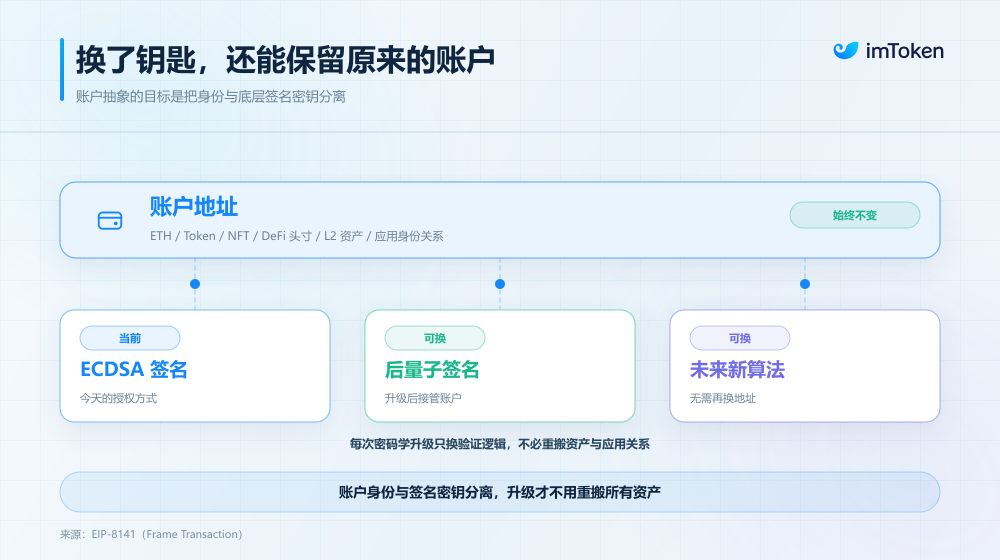
In an article published on November 19, 2026, imToken described Ethereum’s preparations as a migration across accounts, validator signatures and data infrastructure—not a single replacement algorithm. The article said the Ethereum Foundation’s protocol priorities, published that September, set a target of post-quantum resistance across Ethereum L1’s execution, consensus and data layers by December 2029. That is a stated engineering goal, not a completed upgrade.
Why account history matters
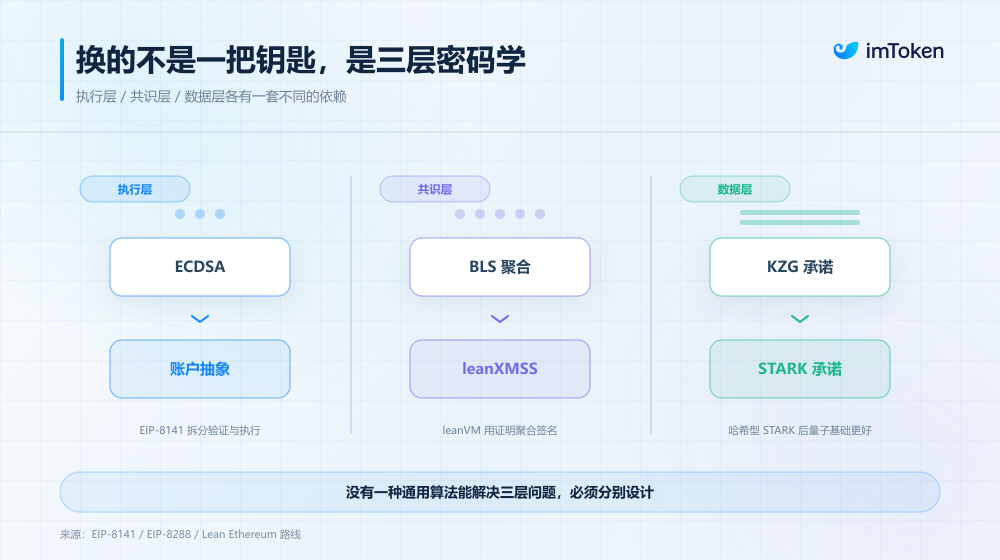
An ordinary Ethereum externally owned account (EOA) uses an ECDSA signature to authorize transactions. Its address is derived by hashing and shortening its public key. According to imToken, an account that has never sent an on-chain transaction or exposed a signature off-chain does not have its full public key exposed in that way. Once it signs a public transaction, the signature can reveal the public key.
A sufficiently capable, fault-tolerant quantum computer running Shor’s algorithm could, in theory, derive an elliptic-curve private key from its public key. That would threaten ECDSA account signatures and the BLS signatures used by Ethereum validators. imToken stressed that no quantum computer capable of breaking this cryptography existed at the time of its report; it did not advise users to rush to move funds.
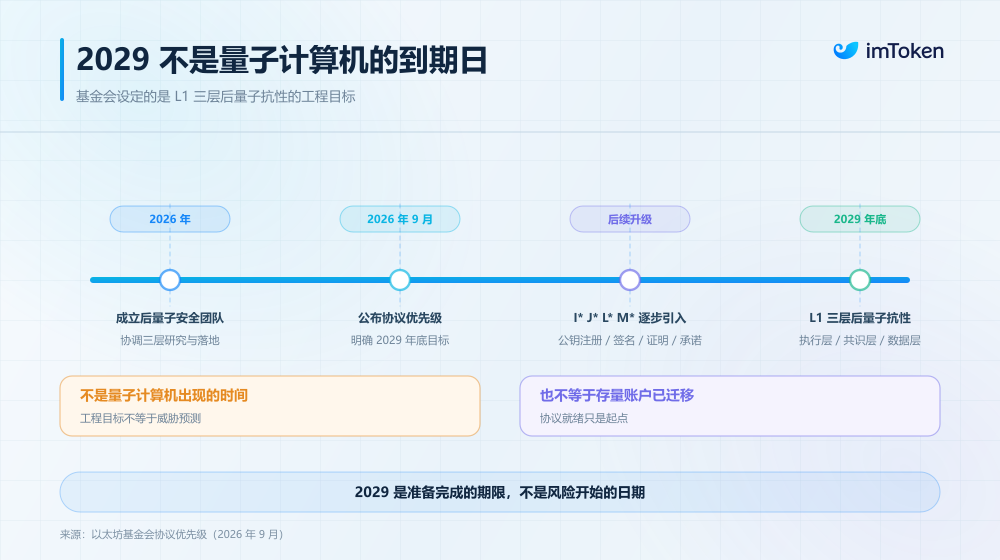
The distinction is also important for developers assessing other components. imToken said hash functions such as Keccak-256 are more resilient to the relevant quantum attacks than elliptic-curve signatures. It identified KZG polynomial commitments, used with blobs and rollup data availability, and some pairing-based zero-knowledge proofs as further areas requiring review. Hash-based STARK proofs do not rely on the same elliptic-curve assumption.
Proposed changes, not deployed protections
At the account layer, imToken pointed to EIP-8141, a native account-abstraction proposal. Account abstraction would let programmable validation logic determine whether an account authorizes a transaction, rather than binding that decision permanently to one ECDSA key. The proposal aims to separate validation, execution and gas payment, leaving room for key rotation and different signature schemes. It does not mean existing EOAs can already switch to post-quantum signatures while retaining their addresses.
The article also described research into precompiles for verifying post-quantum signatures. Because such signatures can be substantially larger than current signatures, EIP-8288 proposes recursive STARK aggregation to reduce the amount of verification material placed on-chain. Both are presented as proposed or researched approaches, not established network protections.
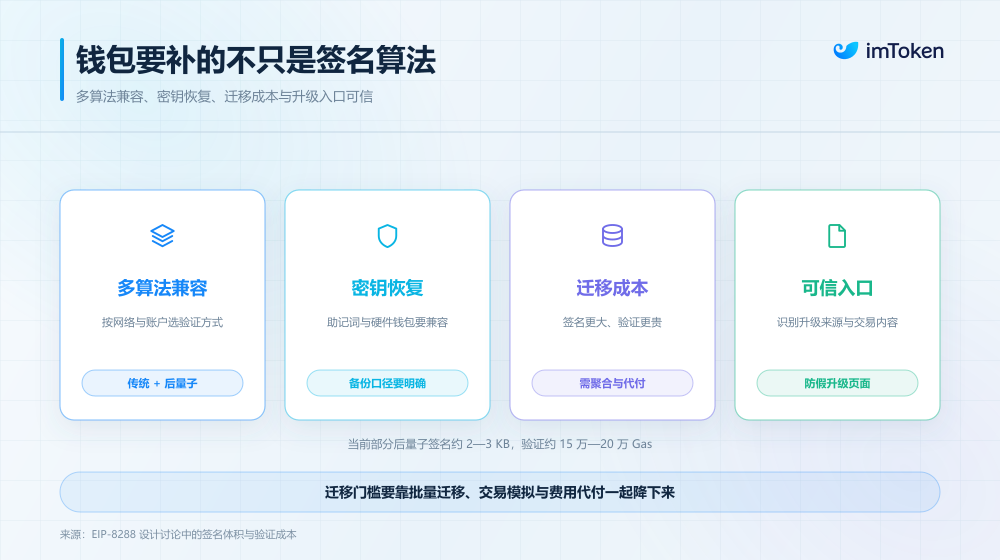
At the consensus layer, imToken described the Lean Ethereum direction: leanXMSS, a hash-based signature candidate for validators, and leanVM, intended to help aggregate their signatures into compact proofs. Replacing BLS would require addressing the network, storage and verification costs of larger signatures.
The migration problem a wallet must solve
A new key alone does not transfer control of an old EOA’s ETH, tokens, NFTs, DeFi positions or permissions recorded against its address. Programmable account validation could, in principle, allow an account to change its authorized key without moving everything to a new address. Where that is not possible, moving assets and rebuilding application relationships would be more involved than a routine key change.
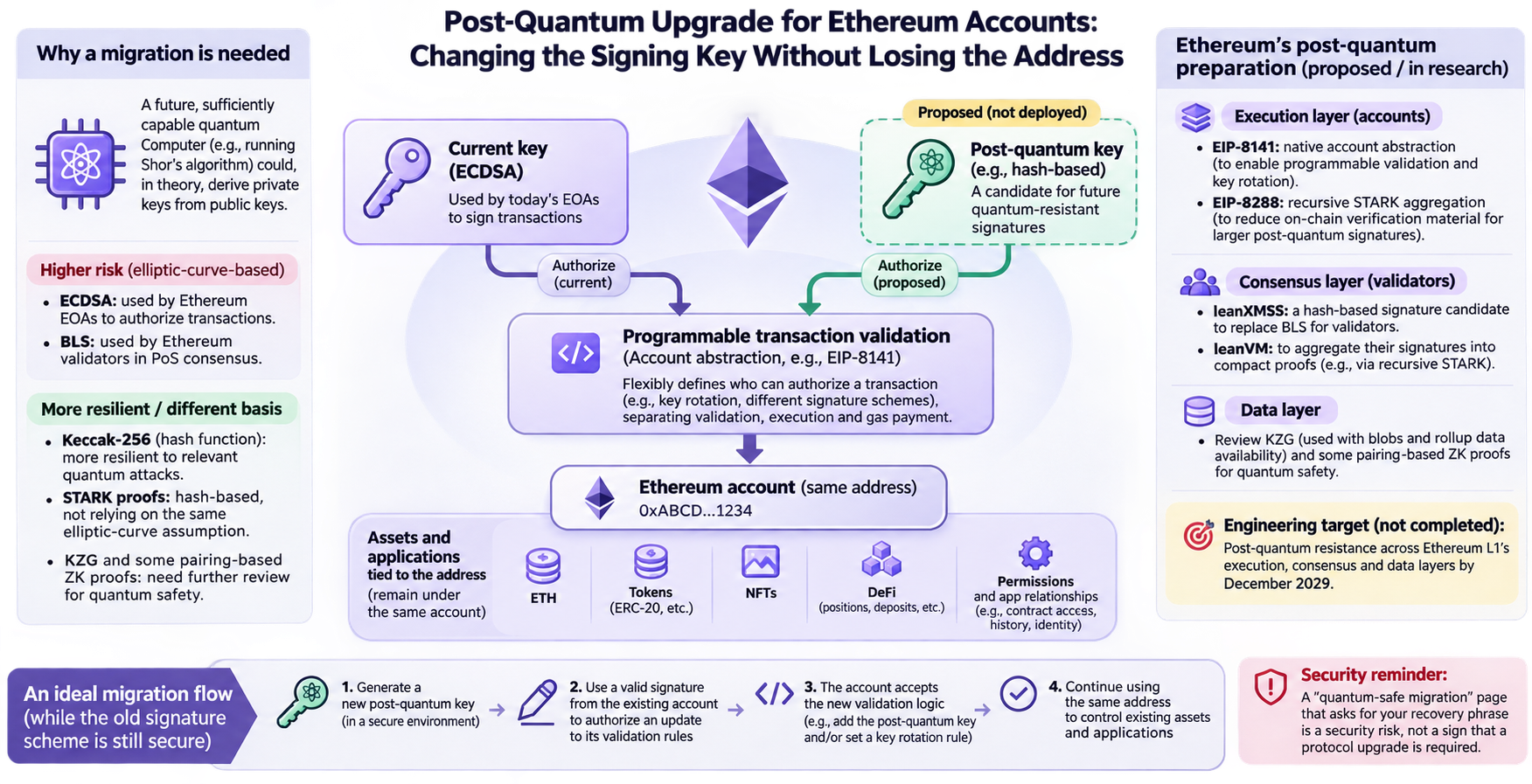
imToken outlined an ideal migration while the old signature scheme is still secure: generate a new post-quantum key and use a valid signature from the existing account to authorize an update to its validation rules. If an attacker could already forge signatures from the old public key, however, an old-key signature alone would no longer reliably distinguish the owner from the attacker. Lost-key and long-inactive accounts pose a separate unresolved question; the article described possible future treatment, including a freeze, as disputed rather than decided.
That leaves a practical design requirement alongside the cryptography: any wallet upgrade flow must make the source of an upgrade, the transaction being signed and the resulting account permissions understandable. A purported “quantum-safe migration” page asking for a recovery phrase would be a security risk, not evidence that a protocol upgrade is required.