
Developers building an AI agent to manage a wallet or pay for a computing service can find tools for both tasks on solana.ai. Solana introduced the platform on November 23, 2026. According to its website, the tools let agents transact without seeking human approval for each action.
Connecting an agent to a wallet or service
The Solana AI Toolkit includes the open-source Solana Agent Kit, a Model Context Protocol server, an agent registry and developer resources. Builders can use the toolkit to connect an agent to blockchain services so it can transfer tokens, swap one asset for another or interact with decentralized finance protocols. Milo, a trading agent showcased on the site, illustrates the wallet workflow: it is designed to monitor markets around the clock and execute trades through a connected wallet.
For an agent buying a service rather than trading an asset, pay.sh lets it pay in USDC for individual requests without opening a conventional account or managing a separate API subscription. Alibaba Cloud was named a launch partner, with computing services accessible through its API endpoints on pay.sh. Solana says its network can settle payments in approximately 200 milliseconds.
What the payment channel benchmark measured
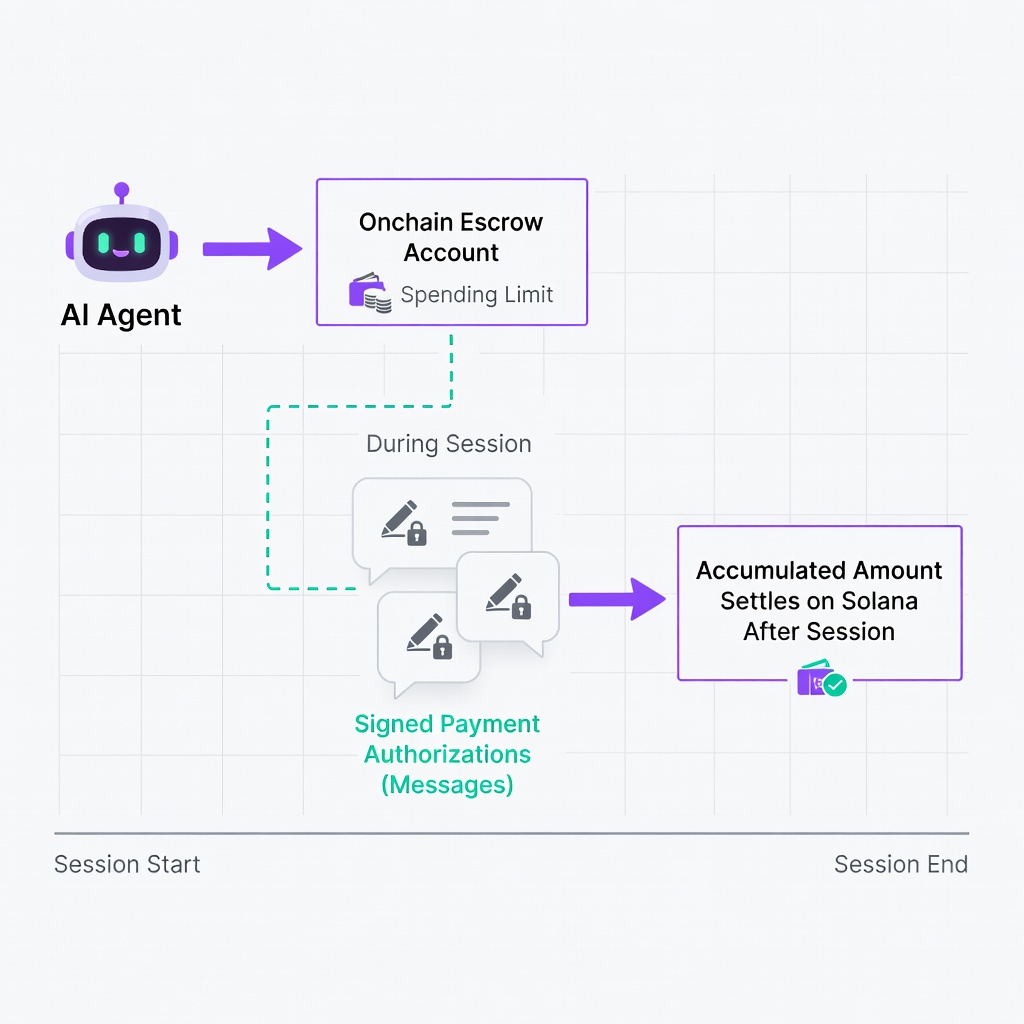
Solana’s Payment Channels separate the authorization of small payments from their final settlement. An agent deposits funds into an onchain escrow account and sets a spending limit. During the session, it authorizes individual payments by signing messages. Only after the session ends does the accumulated amount settle on Solana.
In September 2026, the Solana Foundation reported that a test involving 100,000 wallets processed more than 1 million payment updates per second. The test counted signed payment authorizations, not individually settled blockchain transactions. The Foundation said the benchmark indicated capacity for more than 80 billion payments in 24 hours, at an estimated processing cost of $0.0078 per million payments. Those figures describe test capacity and estimated cost, not a day of actual customer payments.
Polygon tested a similar approach in September, reporting more than 11 million verified payment updates per second across 25 hubs.
Verifying where an agent runs
Confidential Compute, an open-source system developed by Nito in coordination with the Solana Foundation, lets an application process sensitive data inside protected hardware. Verification information recorded on Solana lets the application check whether a result came from approved computing infrastructure. Solana’s documentation describes uses including private AI conversations and trading agents that keep their strategies and signing keys inside the protected environment.
As reported on November 13, 2026, the toolkit supported hardware attestations from Intel TDX and AMD SEV-SNP; verification for NVIDIA GPUs was still in development. At the time of the November 23 report, Confidential Compute was in beta on Solana’s development network. A security audit was underway ahead of a planned mainnet deployment. The Foundation had released Rust and TypeScript software development kits, an onchain verification program and application templates.
The Foundation presented solana.ai as part of its effort to make Solana a network on which agents can carry out transactions. At Breakpoint 2026, it said more than 120 teams were building AI products in the wider Solana ecosystem. On November 9, it had listed AI inference and stablecoin payments among 11 startup opportunities, with grants and technical support available through its Builder Program.