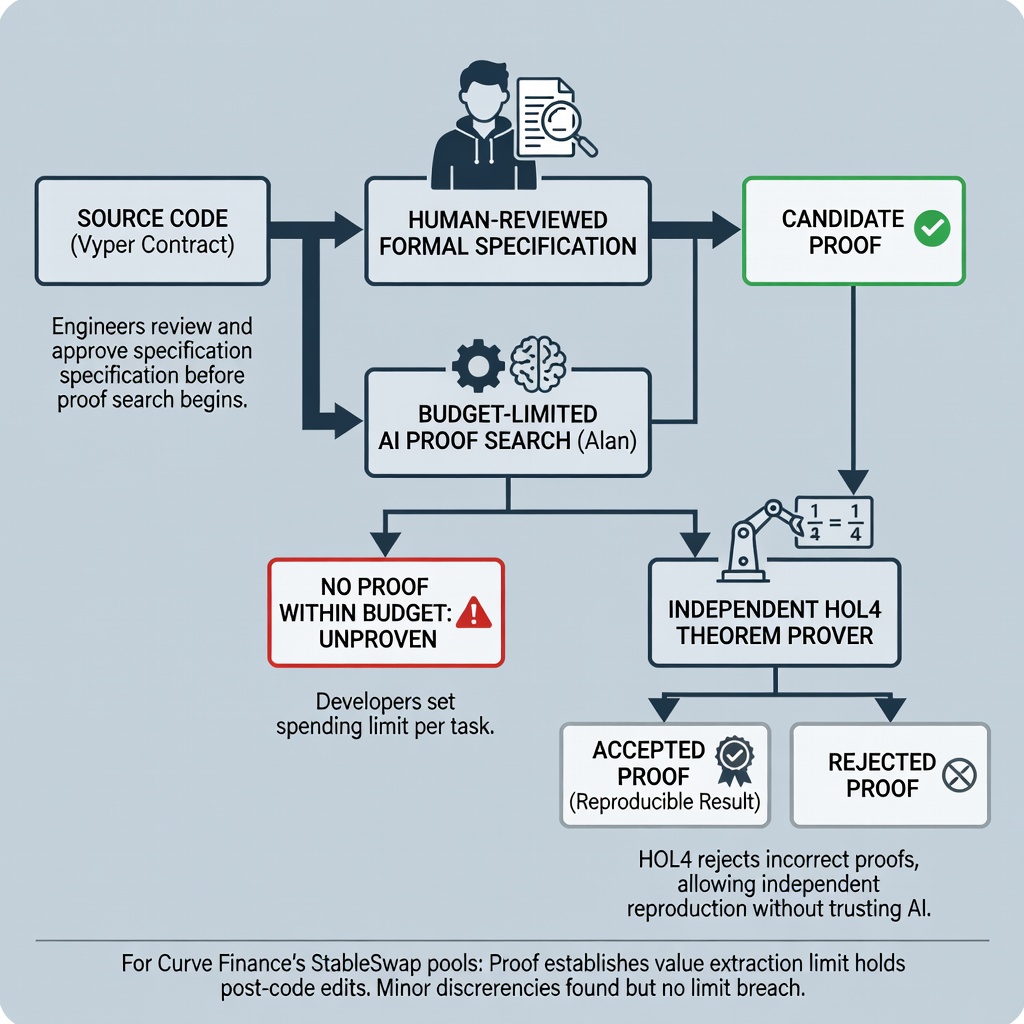
For a developer changing a Curve liquidity pool, the question is whether the revised code still limits how much value a user can extract from depositors. London-based Sequent has used its verification platform, Alan, to establish such a limit for Curve Finance’s two-asset StableSwap pools that hold standard tokens. The work turned up minor accounting and rounding discrepancies, but none breached the limit.
A November 25, 2026 report identified Curve as Sequent’s first paying customer and put the startup’s pre-seed funding at $2.2 million. Frachtis and Metaplanet Holdings OÜ, the investment firm of Skype co-founder Jaan Tallinn, co-led the round. Sequent plans to spend the funds on AI computing resources and hiring in engineering, sales and marketing as it prepares Alan for a full commercial launch.
What Alan proves
According to Sequent’s product documentation, Alan reads source code and helps developers write a formal specification: a precise statement of the behavior the code must maintain. For a lending contract, that might mean a borrower cannot withdraw more than their available balance. Engineers review and approve the specification before Alan searches for a mathematical proof.
A test checks what happens in a selected scenario. A proof, if successful, establishes that the specified property holds for every execution covered by the mathematical model. A separate theorem prover, HOL4, checks Alan’s proposed proofs and rejects incorrect ones. That lets another reviewer reproduce a successful result without having to trust the AI model.
Developers can set a spending limit for each task. If Alan exhausts that budget without finding a proof, it reports the property as unproven. That outcome neither establishes a flaw nor gives the contract a clean bill of health. For Curve, the value of a proof lies in checking the same property again after an edit. As founder Michael Egorov told The Next Web, when the pool code changes, “we can prove depositors’ money stays protected by the same limit.”
Why the Vyper compiler is a separate project
Sequent’s work with Curve traces back to a Vyper compiler flaw that attackers exploited in July 2023, causing approximately $52 million in reported losses. Charles Cooper, Vyper’s lead maintainer and now Sequent’s chief executive, had introduced the flaw in 2021. Developers fixed the compiler before the attack, but the fix did not change contracts already deployed with code produced by affected versions.
Ramana Kumar, a former Google DeepMind AI safety researcher who co-developed the formally verified compiler CakeML, offered to help establish the correctness of the Vyper compiler. He and Cooper founded Sequent in January 2026. The proof for Curve’s pools does not establish that the compiler itself is correct; that work is still underway.
On November 20, Sequent released Verifereum 1.2.0, its open-source mathematical specification of the Ethereum Virtual Machine, which executes compiled contract code. Sequent says the specification passed all 17,441 official Ethereum execution conformance tests. Developers can examine the specification, proofs and live test results publicly. The release supports analysis of compiled code, including contracts already deployed on Ethereum, and Sequent plans to use it as the machine model for end-to-end verification of the Vyper compiler.
Curve also experienced a separate signature verification flaw on November 10. An attacker stole $38,200 in fees from administrative revenue; customer deposits were not affected.
What developers can use
Alan currently supports Vyper contracts. Solidity and Solana support are in development, while Rust, C, TypeScript and Python remain on the roadmap. Monthly subscription prices start at $99 for individual developers, $200 for security auditors and $500 for development teams. Sequent says auditors can use designated accounts to review a customer’s specifications and independently check proofs before signing off.