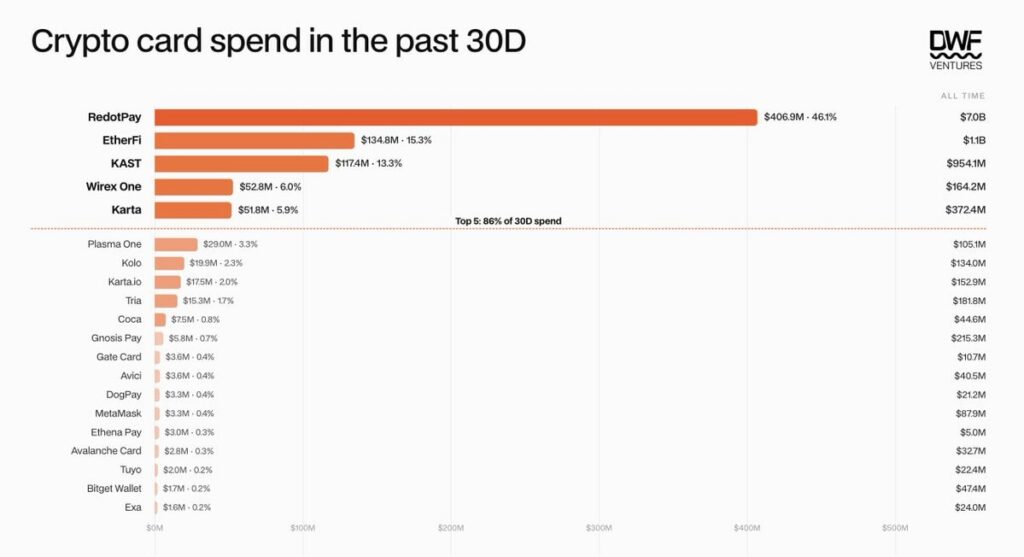
For a team building a stablecoin card app, issuing the card and getting money into a customer’s local bank account are two different jobs. In an article published November 25, 2026, DWF Ventures argued that several leading programs already rely on the same card infrastructure, but few can convert crypto into local currency and deliver it to the accounts customers actually use. That gap matters when a foreign exchange fee of 0.5% to 2% can wipe out most of the cashback on a purchase.
Card spending is growing, but deposits tell a different story
DWF used crypto neobank to mean a company whose main business is issuing crypto payment cards. Earlier mobile-first banks such as Revolut and Nubank won tens of millions of customers with cheaper cross-border payments and faster transfers, but still relied on conventional settlement networks and market-by-market licensing. DWF said stablecoin settlement and payment infrastructure from providers such as Bridge and Rain can give a card program access to dozens of markets at launch. Its potential customers include people paid across borders, small and midsize businesses, and residents with limited access to dollars.
According to PaymentScan data cited in the article, weekly crypto card spending rose nearly 200% year over year. The five largest programs accounted for more than 86% of spending, with RedotPay alone handling more than 46% of volume. DWF attributed the concentration partly to trust in the issuer, brand recognition and early distribution, particularly in Asia-Pacific and Latin American markets with strong demand for dollars.
On average, users spent $0.65 to $0.75 for every dollar loaded. EtherFi and KAST, where users spent a smaller share of their deposits, offered annual percentage yields of 7% to 9% on dollar stablecoin balances. DWF saw that pattern as evidence that some customers valued a place to keep funds and earn a return, not just a way to spend them.
What a card program earns after rewards
Card programs collect fees on purchases, currency and crypto conversions, and transfers into or out of the app. DWF reported that most programs retained less than 1% of card spending after cashback, while subsidies could reach 2% to 3% per dollar spent. Reward caps limit the cost of acquiring customers, but do not establish that a program is profitable. A Blockworks comparison cited in the article found that most programs were still in negative territory on card spending after rewards.
RedotPay competed on reach rather than rewards. According to DWF, it held licenses in Hong Kong, the United States, Canada and Argentina and supported multiple payment methods. DWF argued that customers in parts of Africa and Latin America could find it cheaper and more accessible than conventional remittances, helping it retain market share despite its higher fees.
What on-chain services add to a card app
- Stablecoin issuance: Issuing a stablecoin allows a program to capture income on idle balances that would otherwise go to an issuer such as Circle or Tether. KAST used M0 to issue its stablecoin, while EtherFi worked with Ethena. DWF estimated that, at an assumed 4% yield, EtherFi user balances could generate about $2 million annually. That was a calculation, not reported revenue.
- Secured borrowing: An app can let users borrow against assets they already hold through a lending protocol such as Aave or Morpho, rather than lending from its own balance sheet. DWF reported that ether.fi Cash ran its credit service on Aave V4 and that loan volume had exceeded $47 million.
- Trading: Phantom integrated perpetual contracts, derivatives without an expiry date, through Hyperliquid. DWF said Phantom had become one of Hyperliquid’s leading builders since the integration. Alongside its payment card, the wallet gave users a place to spend, save and trade.
DWF distinguished the challenge of earning depositors’ trust from that of sustaining a yield. Licenses, regulatory protections and a verifiable track record take time to establish, particularly for customers using dollars to preserve savings in a weak local currency. On yield, DWF pointed to Ethena Pay: deposits earn returns from Ethena’s own strategies, and additional deposits increase demand for USDe and generate protocol revenue. DWF viewed dollar-denominated returns as more attractive to a broad customer base than token rewards.
Local payments remain a separate test. Most card spending settles in dollars, so a user who earns or spends another currency may still pay for conversion. DWF’s case for multicurrency settlement and local payouts was not that they guarantee growth, but that they solve a problem shared card infrastructure and cashback leave intact: moving funds in the currency, and into the account, a customer needs.