
For builders, the key distinction in a Polygon proposal reported on November 5, 2026 is between blocking transactions from an address and changing its balance through a hard fork. The first restricts what an address can do; the second would change the chain’s recorded state without a transaction signed by that address’s private key.
According to Odaily, Polymarket and Binance proposed a Polygon PoS hard fork that would remove about 70.49 million POL from five addresses linked to two reported attacks and credit the same amount to recovery addresses they designated. The proposal valued the POL at roughly $6.7 million; elsewhere, the report gave an estimate of about $6.5 million. The offsetting balance changes would leave total POL supply unchanged. This was a proposal, not an enacted fork.
Odaily reported that Polymarket’s front end and a Binance hot wallet were compromised on October 30. It said Polygon validators subsequently froze four addresses associated with the Polymarket incident, holding 23.86 million POL, and one associated with the Binance incident, holding 46.63 million POL. According to the proposal as described by Odaily, Polymarket received no response when it sought the attackers’ cooperation, and the attackers contacted validators with an offer of cash to unfreeze addresses. Those claims were attributed to the proposal, not independently established in the report.
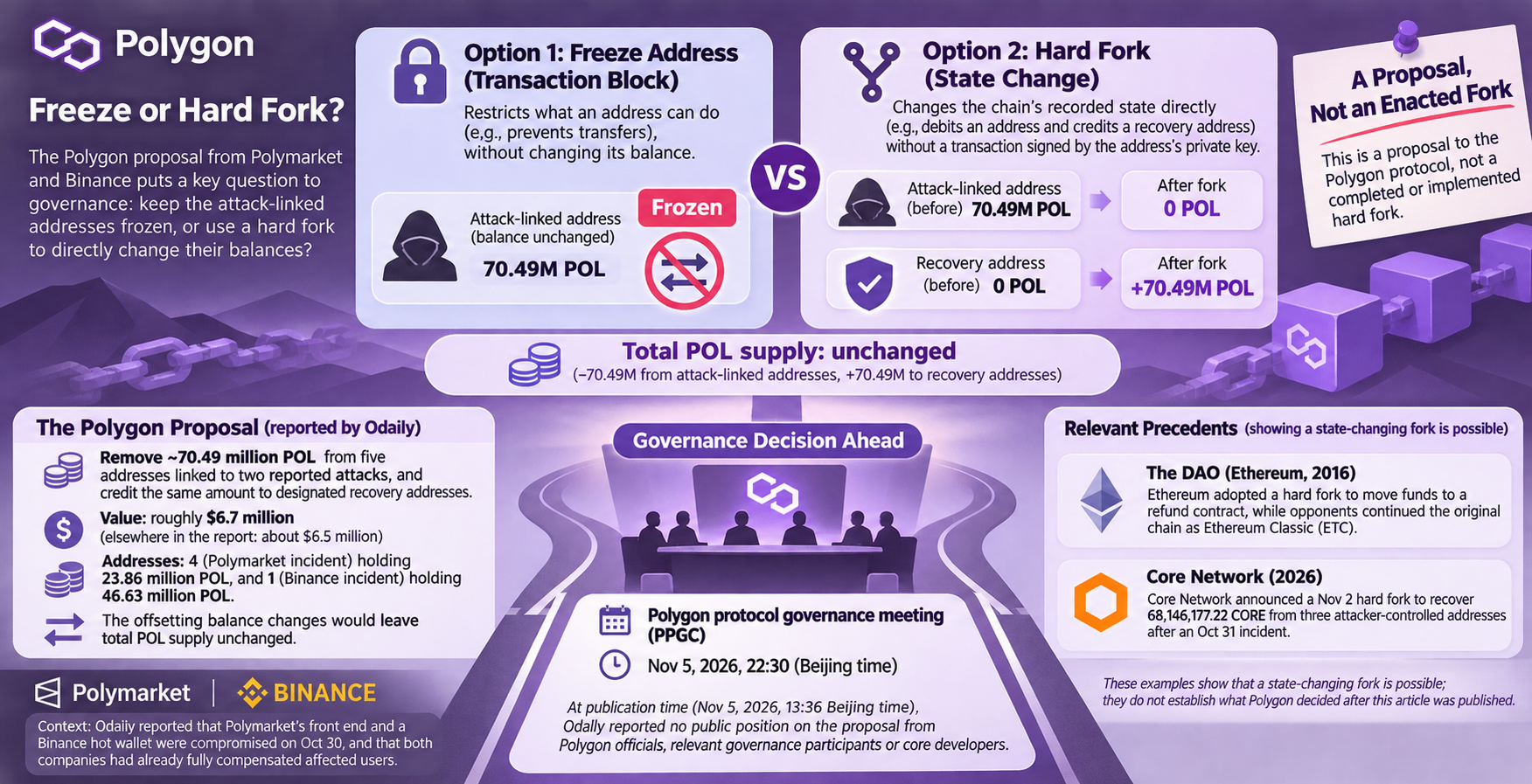
At publication time—November 5, 2026, at 13:36 Beijing time—Odaily said the Polymarket and Binance teams were due to present the proposal at a Polygon protocol governance meeting at 22:30 Beijing time that day. It reported no public position on the proposal from Polygon officials, relevant governance participants or core developers. The article also said both companies had already fully compensated affected users; its assessment that the fork was unlikely to pass was the author’s opinion, not a governance result.
The governance question has a precedent. Following The DAO exploit in 2016, Ethereum adopted a hard fork to move funds to a refund contract, while opponents continued the original chain as Ethereum Classic. Odaily also reported that Core Network announced a November 2 hard fork to recover 68,146,177.22 CORE from three attacker-controlled addresses after an October 31 incident. These examples show that a state-changing fork is possible; they do not establish what Polygon decided after this article was published.
Source: odaily.news (originally published 2026-11-05 13:36 UTC+8)