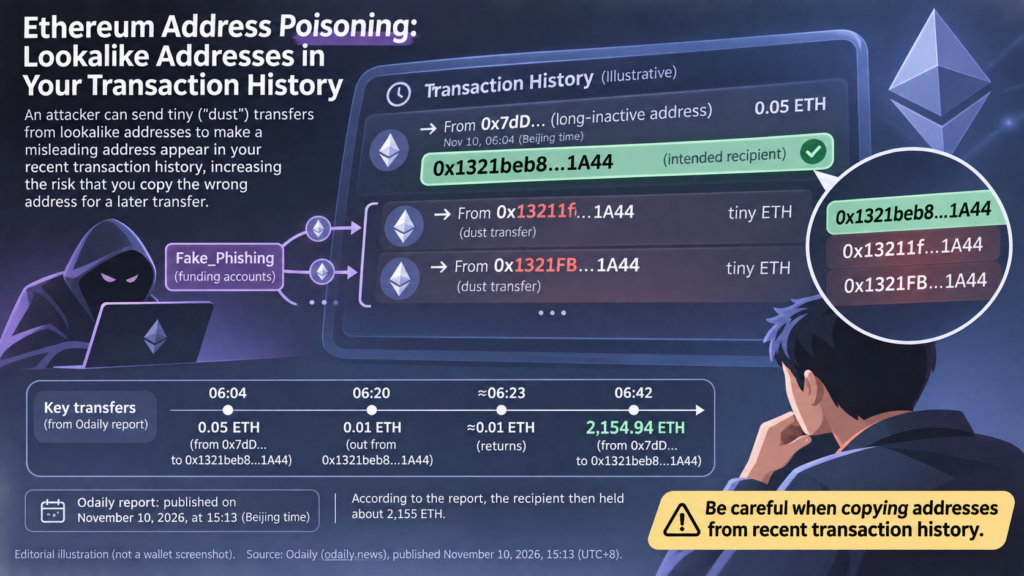
When sending ETH, copying a recipient from recent transaction history can be risky: an attacker can place a similar-looking address in that history. An Odaily report published on November 10, 2026, at 15:13 Beijing time described such an address-poisoning attempt around a long-inactive Ethereum address.
According to Whale Alert data cited by Odaily, the address beginning 0x7dD received ETH in Ethereum’s genesis block in July 2015 and another 755 ETH in March 2016. It had not sent ETH out before transferring 0.05 ETH, worth about $106, at 06:04 Beijing time on November 10. The recipient began 0x1321beb8 and ended 1A44.
About three minutes later, the address received multiple tiny ETH transfers from two lookalike addresses. They began 0x13211f and 0x1321FB, respectively, and both ended 1A44. Accounts funding those addresses were labeled “Fake_Phishing”; the more active lookalike address sent 43 dust transfers. Address poisoning is the attempt to make a misleading address appear in a target’s transaction history so the target copies it for a later transfer. The report does not establish who sent the dust transfers or whether the holder noticed them.
At 06:20, the recipient of the initial transfer sent out 0.01 ETH, nearly all of which returned about three minutes later. At 06:42—roughly 38 minutes after the first transfer—the older address sent 2,154.94 ETH, worth about $4.6 million, to the intended address beginning 0x1321beb8 and ending 1A44. Odaily reported that the recipient then held about 2,155 ETH.
Source: odaily.news (originally published 2026-11-10 15:13 UTC+8)