
For a wallet builder, the central question is not just how a user creates a key, but what must be trusted to recover it. In an article published on November 10, 2026, Liu Jiaolian compared four approaches after reporting that assets had been transferred from thousands of Keplr social-login wallets. Liu said Keplr had pointed to a vulnerability in Web3Auth infrastructure, while the detailed cause had not yet been disclosed. That attribution is not a confirmed technical explanation of the incident.
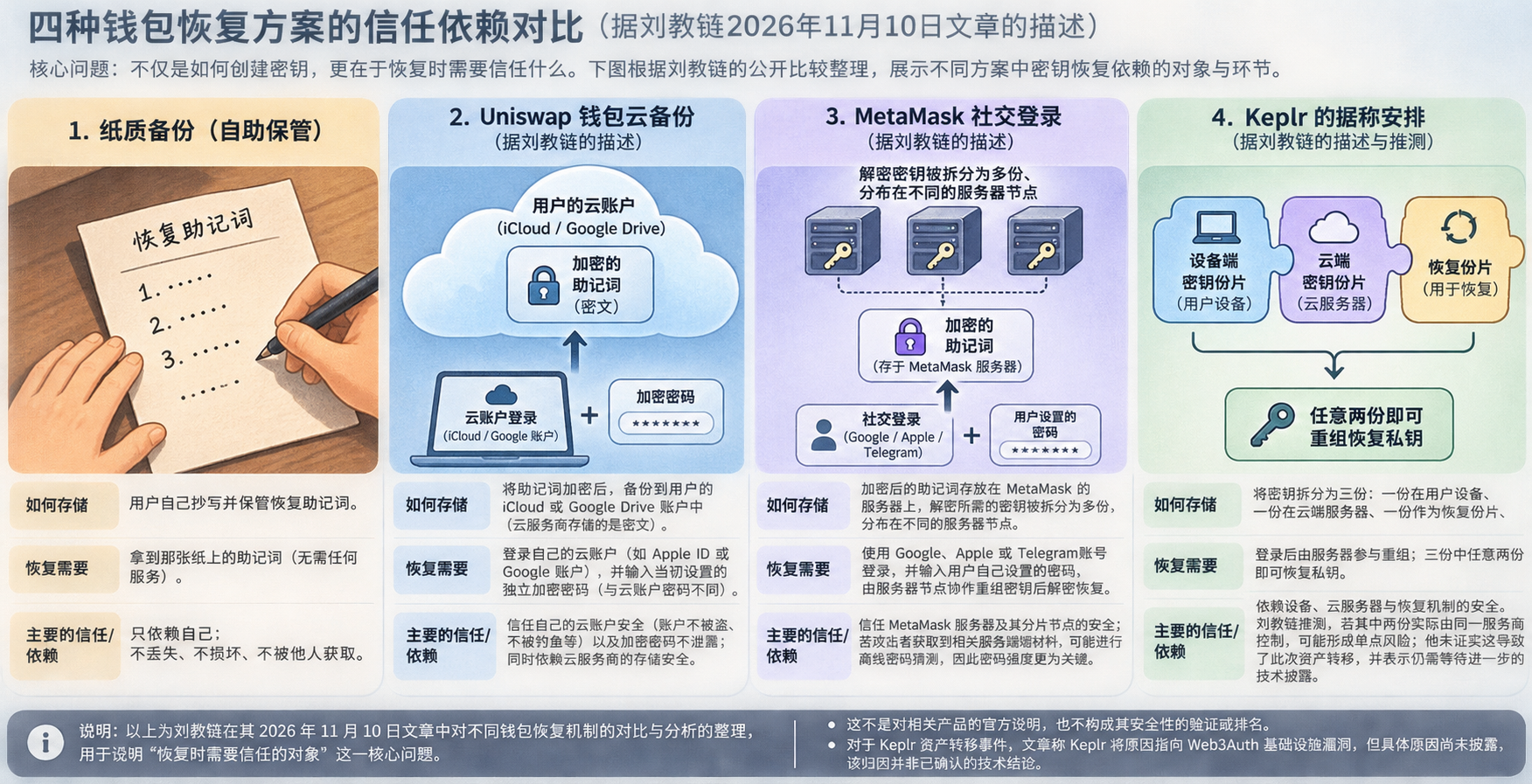
Where recovery depends on trust
- Paper backup: A user writes down and safeguards their own recovery phrase. There is no recovery service in this model, but loss, damage or disclosure of the paper can put access at risk.
- Uniswap wallet cloud backup: Liu described an encrypted recovery phrase stored in the user’s iCloud or Google Drive account. Recovery requires access to that account and the separate password used to encrypt the phrase. The cloud provider stores ciphertext, but account compromise or exposure of the encryption password remains a concern.
- MetaMask social login: In Liu’s description, an encrypted phrase is stored on MetaMask’s servers, while the key needed to decrypt it is split among server nodes. Recovery requires a Google, Apple or Telegram login and a user-set password. Liu argued that if an attacker obtained the relevant server-side material, offline password guessing could bypass online rate limits, making password strength more important.
- Keplr’s reported arrangement: Liu described three key shares: one on the user’s device, one on a cloud server and one for recovery. His account says any two can reconstruct the private key, with a server participating after login. He speculated that control of two shares by one provider could create a single point of failure. He did not establish that this caused the reported transfers and said further technical disclosure was needed.
The comparison is about who controls each recovery dependency, not a ranking of these wallets’ proven security. Liu’s broader argument was that easier recovery can reduce mistakes users make with paper backups while introducing service providers and systems that users may find harder to assess. The Keplr incident’s actual failure path remained unresolved in his November 10 account.