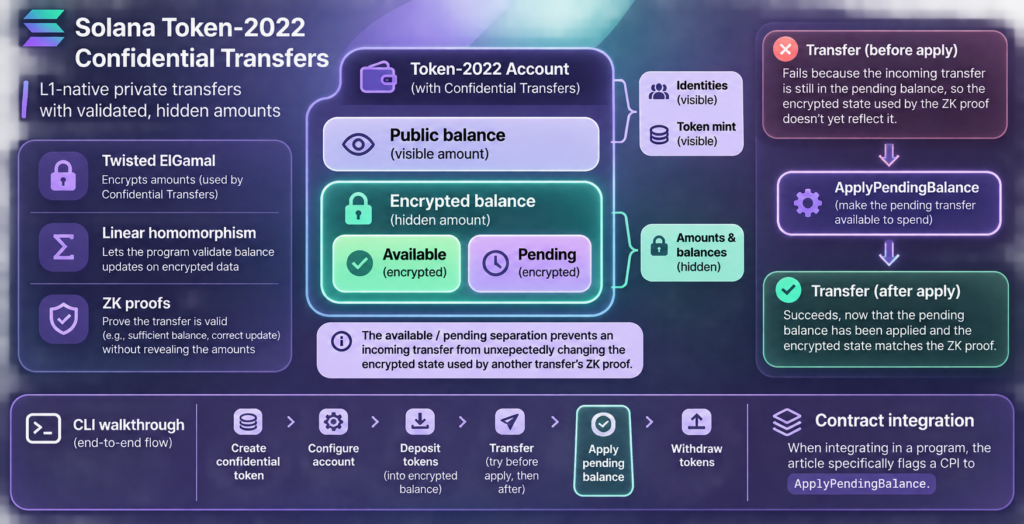
For a builder integrating Solana Token-2022 Confidential Transfers, the key distinction is between moving tokens into an encrypted balance and making a pending encrypted transfer available to spend. An article published on November 16, 2026 walks through both steps, including a transfer that fails before apply-pending-balance and succeeds afterward.
The Confidential Transfers extension hides amounts and balances, not the identities of the transacting parties or the token mint. Accounts hold both a public balance and an encrypted balance. The article describes how Twisted ElGamal encryption, its linear homomorphic property, and zero-knowledge (ZK) proofs are used to validate transfers without exposing the protected amounts.
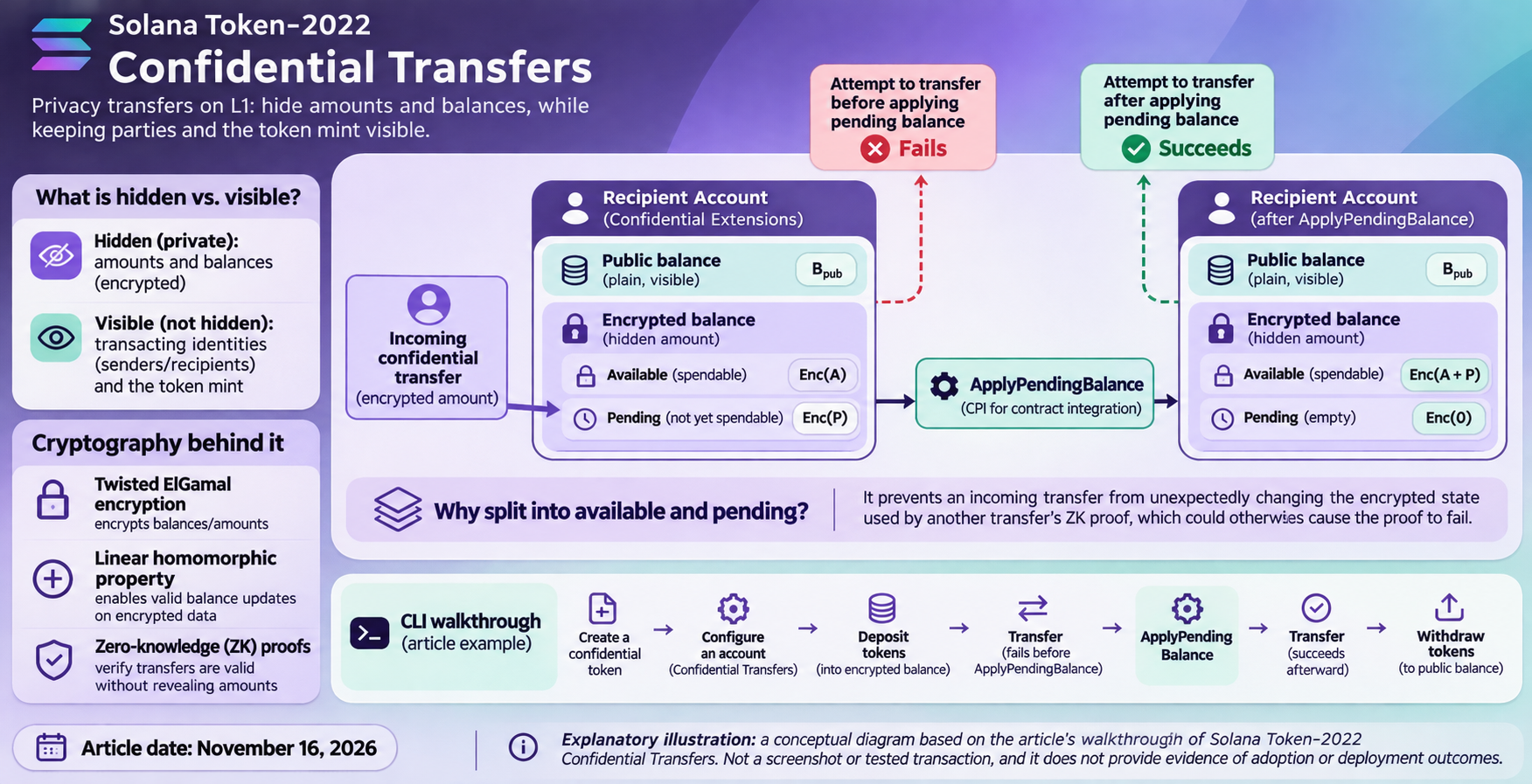
Its command-line interface (CLI) walkthrough covers creating a confidential token, configuring an account, depositing tokens, transferring, applying a pending balance, and withdrawing. The encrypted balance is split into available and pending portions. According to the article, that separation prevents an incoming transfer from unexpectedly changing the encrypted state used by another transfer’s ZK proof. The failed-then-successful transfer in the walkthrough illustrates why applying the pending balance matters.
For contract integration, the article specifically flags a cross-program invocation (CPI) to ApplyPendingBalance. It does not provide evidence here of adoption or deployment outcomes.