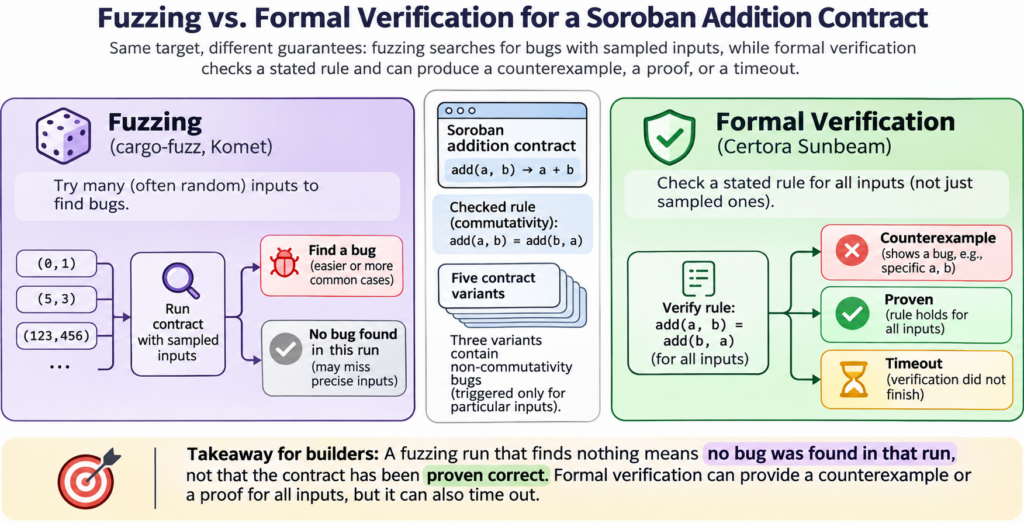
When checking whether a smart contract behaves as intended, finding no bug is not the same as proving there is none. A comparison published on September 1, 2026, used a simple Soroban addition contract to show the difference.
The comparison tested five contract variants with the fuzzing tools cargo-fuzz and Komet, and the formal verification tool Certora Sunbeam. Three variants contained non-commutativity bugs that appeared only for particular inputs. Fuzzing quickly found obvious or easier-to-trigger bugs but missed defects requiring precise inputs.
Formal verification offered a different result for a checked rule: it could produce a counterexample or prove that the rule held for all inputs. It could also time out. For a builder, the distinction is practical: a fuzzing run that finds nothing means no bug was found in that run, not that the contract has been proven correct.