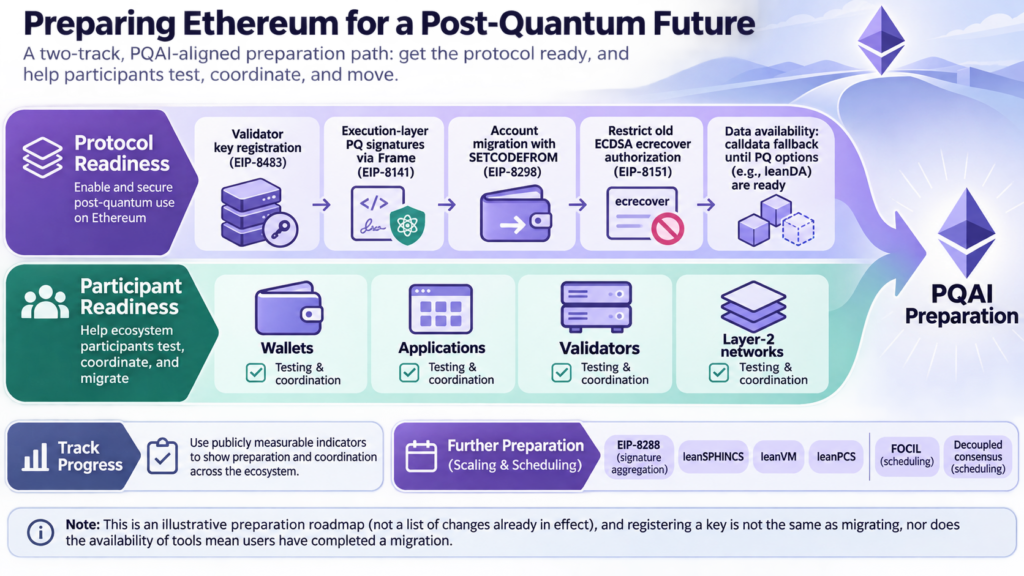
For builders planning a post-quantum transition, a key distinction is whether the protocol supports new signatures and whether its participants have actually moved to them. In the third article of its Ethereum post-quantum migration series, published on November 19, 2026, LambdaClass uses Ethlabs’ “PQAI” concept to frame preparation along those two tracks. Its roadmap is illustrative, not a list of changes already in effect.
On the protocol side, the roadmap proposes that validators first register post-quantum key material under EIP-8483. Frame transactions under EIP-8141 would enable post-quantum signatures on the execution layer. Accounts could then migrate using SETCODEFROM under EIP-8298, while EIP-8151 would restrict authorization through the older ECDSA-based ecrecover mechanism. For data availability, the article calls for a calldata fallback until post-quantum approaches such as leanDA are ready.
The participant side requires separate work. LambdaClass stresses that registering a key is not the same as migrating, and making tools available does not mean users have completed a migration. Wallets, applications, validators and layer-2 networks would each need advance testing and coordination. The article also calls for publicly measurable indicators of progress.
Looking further ahead, it discusses signature aggregation under EIP-8288, leanSPHINCS, leanVM and leanPCS as scaling directions, alongside scheduling questions involving FOCIL and decoupled consensus. These are parts of the proposed preparation path, not evidence that the transition is complete.