
For an Ethereum validator operator, draft EIP-8502 poses a practical question: would keeping stake in separate validators carry a cost? As reported on November 19, 2026, Ethereum Foundation researcher Anders Elowsson had submitted the consensus-layer proposal to an Ethereum repository. It was a draft, not an active fee rule.
The proposal would encourage operators to consolidate smaller validator positions using the voluntary consolidation capability introduced by EIP-7251. Its stated aim is to reduce the number of active validators and the associated signature-aggregation work on Ethereum’s beacon chain. The report put the active validator count at approximately 815,000 on November 19, with about 44.01 million ETH staked and an average effective balance of roughly 54 ETH per validator.
Under the draft, a validator’s balance would be reduced each epoch—a recurring period used by the consensus system—by a fee tied to its effective balance and how far the network’s active-validator count exceeds a changing target. The proposed rate is highest for a validator at 32 ETH and falls linearly to zero at the 2,048 ETH maximum effective balance. In an extreme case, the deduction for a 32 ETH validator could equal its entire attestation reward, the reward associated with voting on the chain’s state.
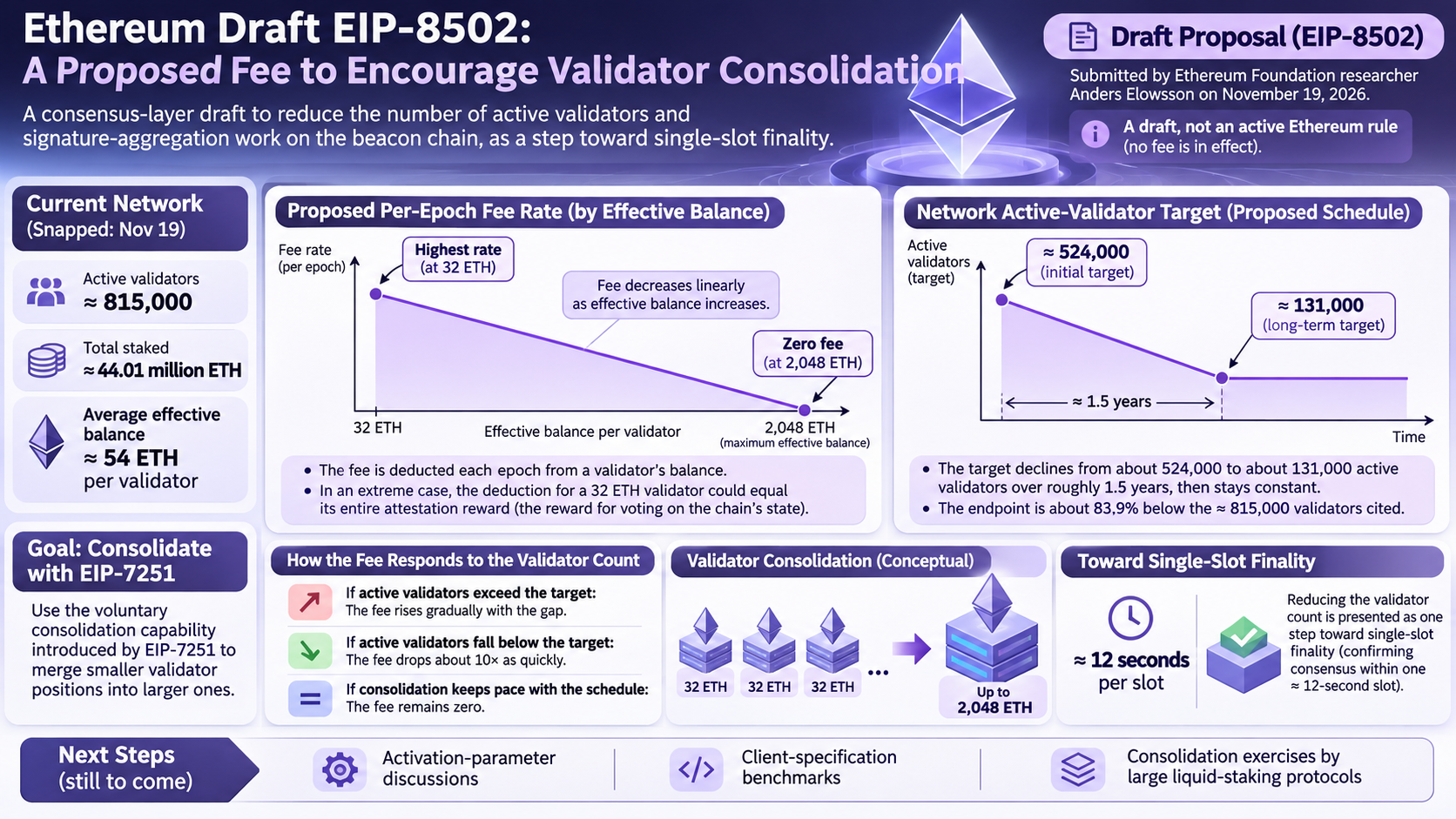
The draft describes an example target that declines from about 524,000 active validators to about 131,000 over roughly 1.5 years, then stays constant. The report says that endpoint would be about 83.9% below the approximately 815,000 validators it cited. If the count exceeds the target, the proposed fee rises gradually with the gap; if it falls below target, the fee drops about 10 times as quickly. The fee would remain zero if consolidation kept pace with the proposed schedule.
Reducing validator count is presented as one step toward single-slot finality: confirming consensus within one roughly 12-second Ethereum slot. The draft does not establish that outcome or a deployment date. The report identified activation-parameter discussions, client-specification benchmarks and consolidation exercises by large liquid-staking protocols as work still to come.