
For vault developers, the reported sBOLD exploit turns on a specific accounting question: what happens to a depositor’s claim when assets entering a vault are not valued correctly? In reporting published on November 19, 2026, K3 Capital’s Ethereum sBOLD savings vault was said to have lost about $3.4 million in liquidity across 97 transactions in roughly eight minutes.
The reported accounting failure
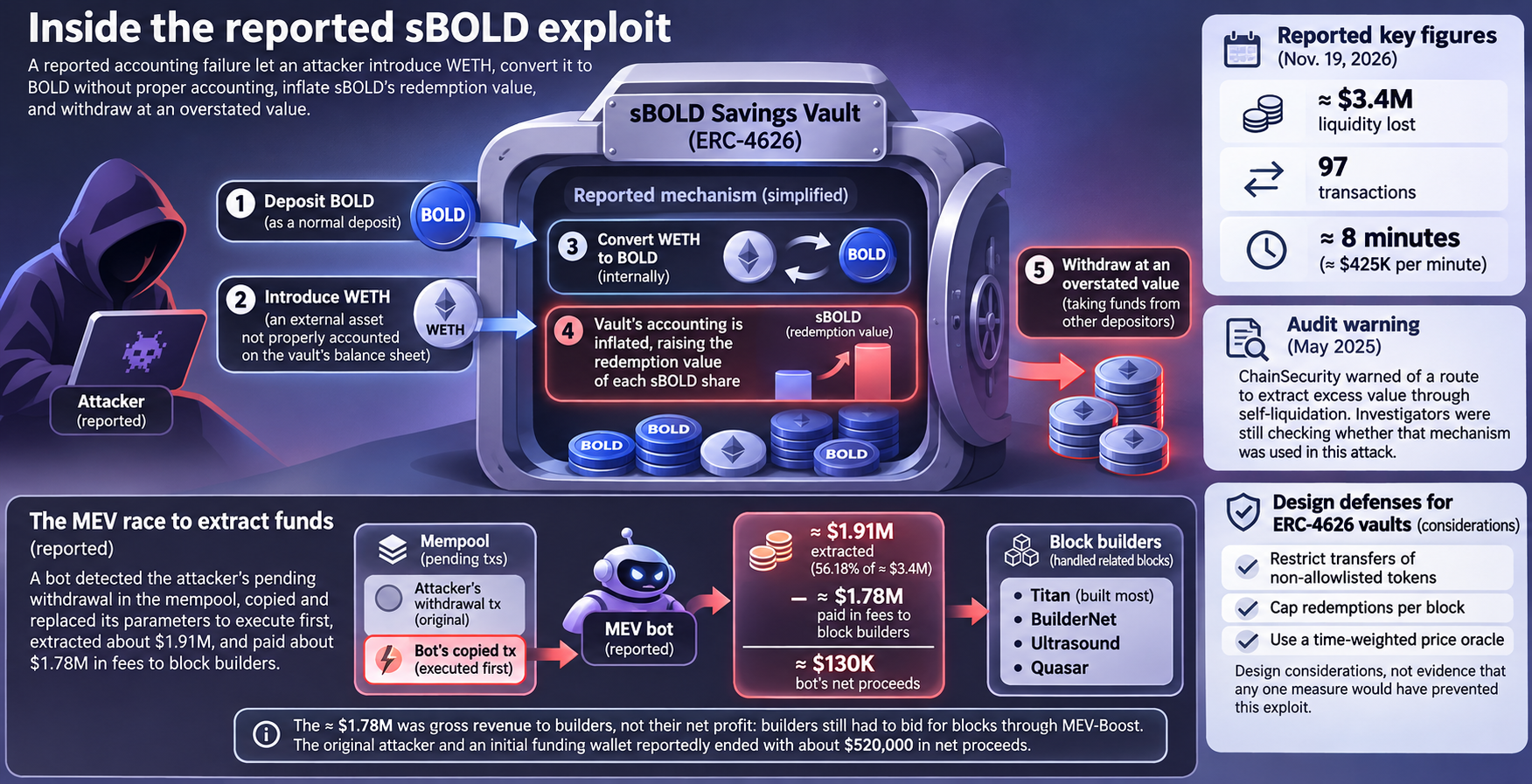
sBOLD is a yield-bearing vault built around BOLD, the stablecoin associated with Liquity. According to transaction analysis attributed to Bitquery, the attacker repeatedly deposited BOLD, introduced wrapped ether (WETH) that was not accounted for on the vault’s balance sheet, and converted it internally to BOLD. This allegedly inflated the redemption value of each sBOLD share, allowing withdrawals at an overstated value from funds deposited by other users.
The distinction matters for builders: the reported failure was not simply that an outside token reached the vault. It was how the vault accounted for that asset when calculating what its shares could redeem.
The race to extract funds
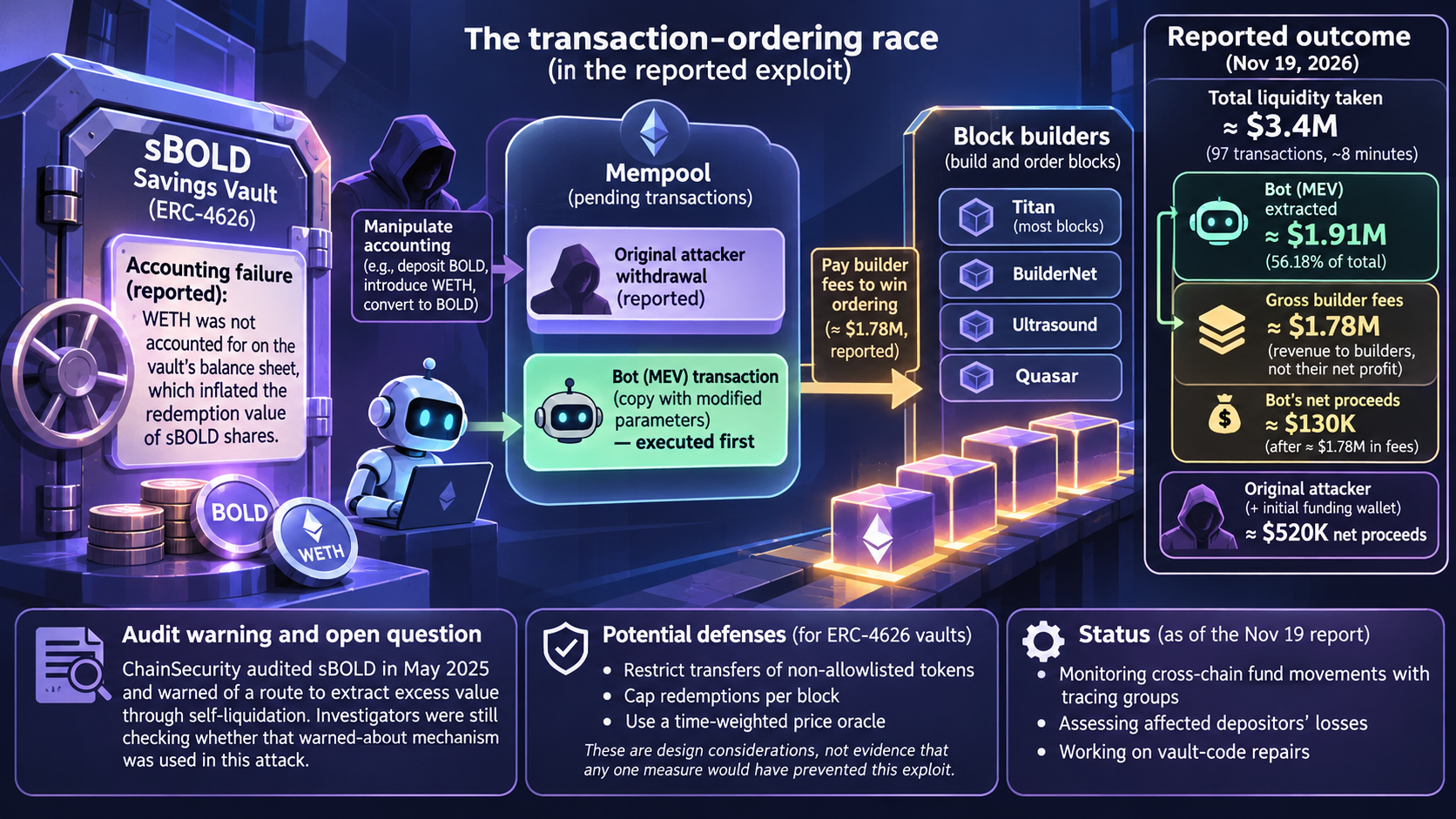
Bitquery’s account says an automated bot detected the original attacker’s withdrawal transaction in the mempool—the pool of pending transactions—and copied and replaced its parameters to execute first. It reportedly extracted about $1.91 million, or 56.18% of the approximately $3.4 million taken. To win the ordering race, the bot paid about $1.78 million in fees to block builders, leaving it with roughly $130,000 after those fees.
The report says Titan built most of the blocks containing the bot’s transactions, while BuilderNet, Ultrasound and Quasar also participated in ordering related blocks. On-chain researchers cautioned that the $1.78 million was gross revenue to builders, not their net profit: builders still had to bid for blocks through MEV-Boost. The original attacker and an initial funding wallet reportedly ended with about $520,000 in net proceeds.
Audit warning and unresolved question
ChainSecurity audited sBOLD in May 2025 and warned of a route to extract excess value through self-liquidation. The report says investigators were still checking whether that warned-about mechanism was used in this attack; the earlier warning does not establish that it was.
For ERC-4626 vaults, the report identifies restricting transfers of non-allowlisted tokens, capping redemptions per block and using a time-weighted price oracle as potential defenses. Those are design considerations, not evidence that any one measure would have prevented this exploit. At the time of the November 19 report, the team was monitoring cross-chain fund movements with tracing groups, assessing affected depositors’ losses and working on vault-code repairs.