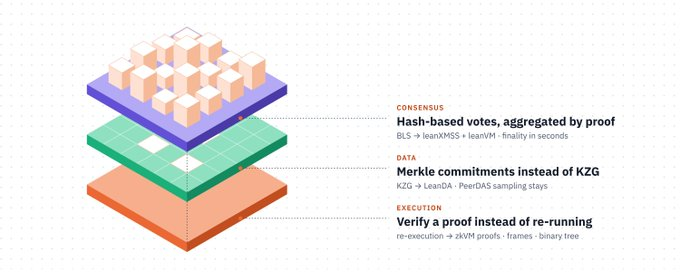
For Ethereum builders, a change in signature schemes is not just a cryptography upgrade. Accounts must be able to authorize transactions under new rules, and those rules must reach the network without breaking assumptions that deployed contracts already rely on. That tension runs through the post-quantum roadmap discussed at Devcon 8.
This article reflects reporting published on November 10, 2026, at 10:59 a.m. UTC+8. The milestones below were plans or proposals at that time, not completed upgrades.
A faster research target than the formal deadline
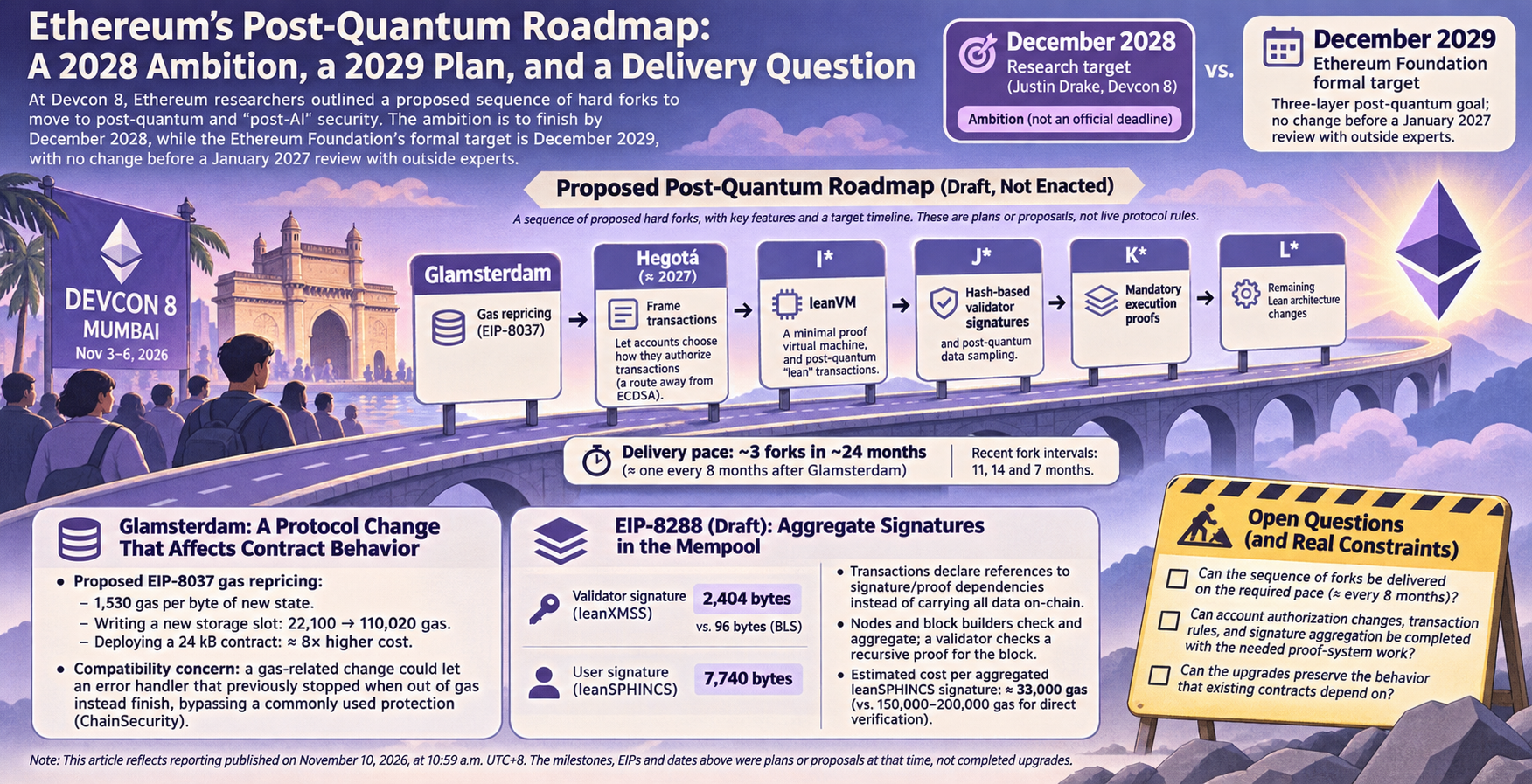
At Devcon 8 in Mumbai, held November 3–6, Ethereum Foundation researcher Justin Drake said he hoped to complete a post-quantum and “post-AI” transition by December 2028. The foundation’s formal priority plan instead set December 2029 as its three-layer post-quantum target and said that date would not change before a review with outside experts in January 2027. The 2028 date was therefore an ambition, not a revised official deadline.
The draft roadmap places the work across successive hard forks. Hegotá, targeted for 2027, would introduce frame transactions, allowing accounts to choose how they authorize transactions—a route away from reliance on ECDSA signatures. A later fork, provisionally called I*, would introduce leanVM, a minimal proof virtual machine, and post-quantum “lean” transactions. J* would add hash-based validator signatures and post-quantum data sampling. K* and L* would carry mandatory execution proofs and the remaining Lean architecture changes. These are roadmap proposals, not enacted protocol rules.
Reaching Drake’s 2028 goal would require three forks in roughly 24 months after Glamsterdam, or about one every eight months. The source contrasts that pace with recent intervals of 11, 14 and seven months. Whether the roadmap can be delivered on that schedule is an open question.
Why Glamsterdam matters to contract developers
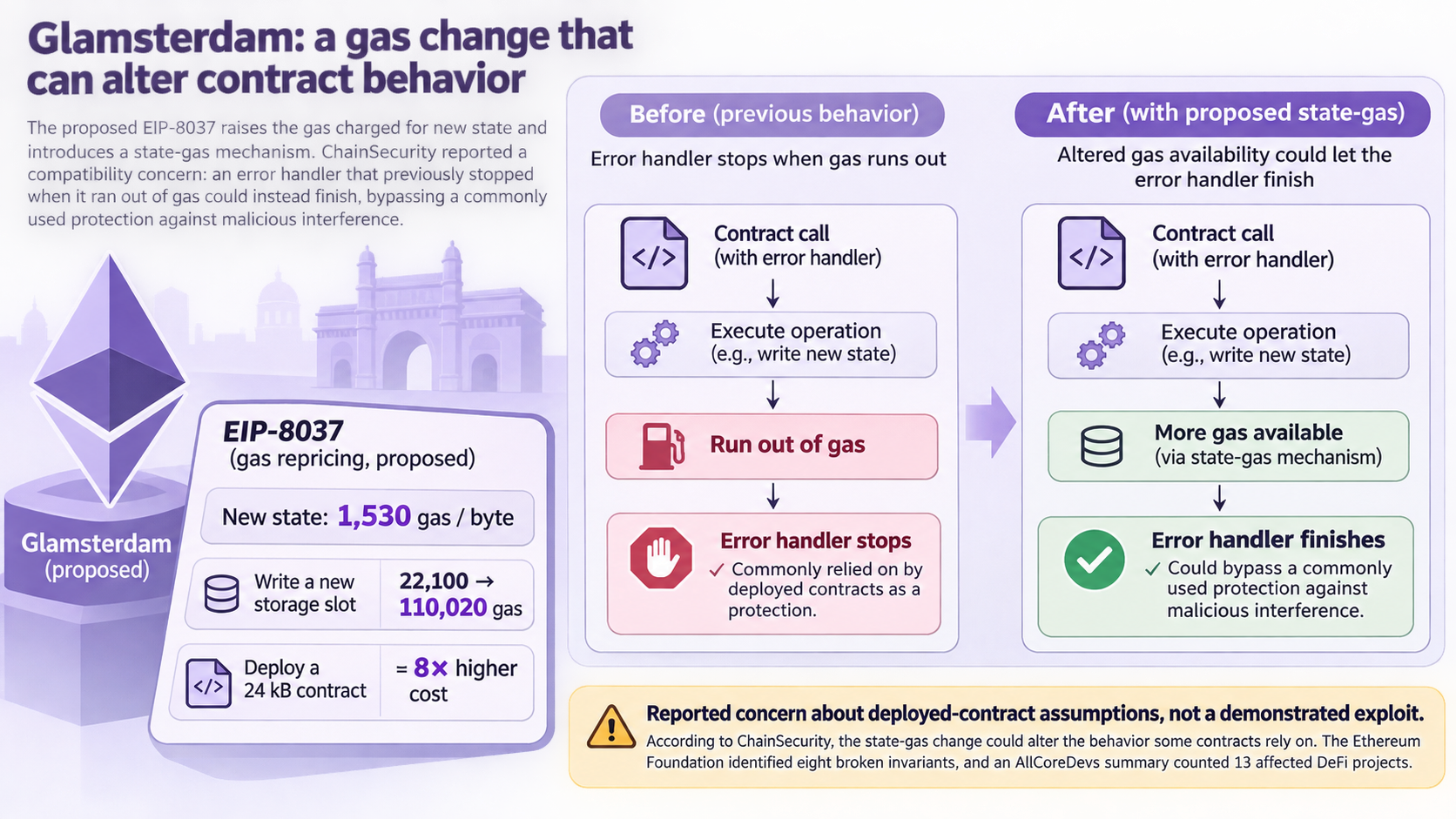
Glamsterdam illustrates how a protocol change can affect contract behavior even when the change is not aimed at a particular application. Its proposed EIP-8037 gas repricing would charge 1,530 gas per byte of new state. The source reports that writing a new storage slot would rise from 22,100 to 110,020 gas, while deploying a 24 kB contract would cost about eight times as much.
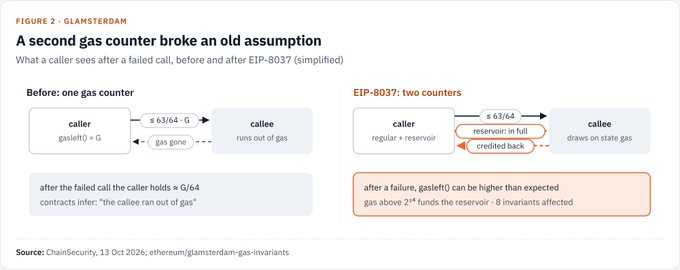
The accompanying state-gas mechanism raised a compatibility concern: according to ChainSecurity, an error handler that previously stopped when it ran out of gas could instead finish, bypassing a commonly used protection against malicious interference. The Ethereum Foundation identified eight broken invariants, and an AllCoreDevs summary counted 13 affected DeFi projects. The Hoodi testnet was delayed; at the time of the report, neither a new Hoodi date nor a mainnet date had been given. All Core Devs coordinator Nixo wrote that Glamsterdam’s mainnet launch would “likely” move into 2027.
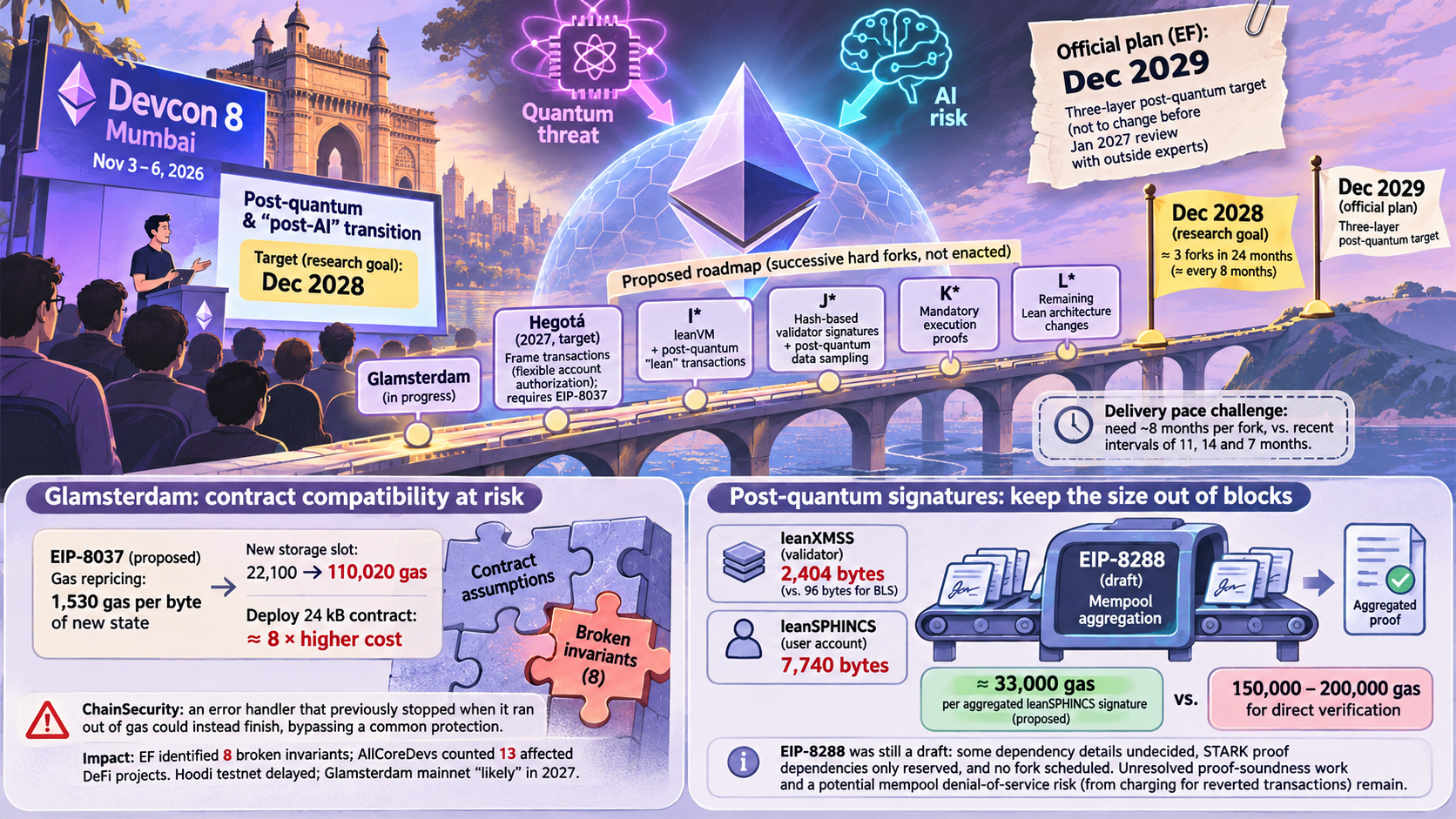
This matters for the later roadmap because Hegotá’s proposed frame transactions list EIP-8037 as a requirement. Gas accounting is observable contract behavior, not merely an internal pricing detail.
Keeping larger signatures out of blocks
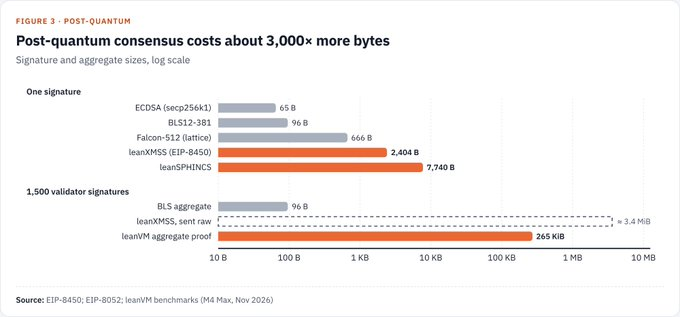
Post-quantum signatures present another engineering constraint: size. The source gives a proposed leanXMSS validator signature as 2,404 bytes, compared with 96 bytes for a BLS signature. It also describes a 7,740-byte leanSPHINCS signature for user accounts. Hash-based signatures cannot be combined in the same way as BLS signatures, so the proposed approach uses proofs that an aggregator checked them.
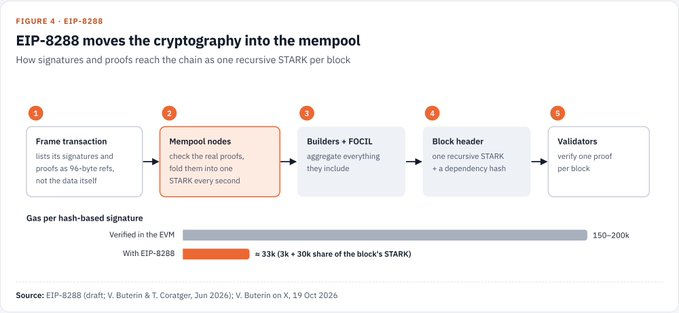
Draft EIP-8288, co-written by Vitalik Buterin and Thomas Coratger, explores aggregation in the mempool—where transactions wait before inclusion in a block. Under the proposal, a transaction would declare references to its signature or proof dependencies rather than carry all that data on-chain. Nodes and block builders would check and aggregate the underlying material, while a validator would check a recursive proof covering the block’s dependencies. The source estimates about 33,000 gas per aggregated leanSPHINCS signature, versus 150,000–200,000 gas for direct verification.
Those figures describe the proposed design, not a live feature. EIP-8288 was still a draft: some dependency details were marked undecided, support for STARK proof dependencies was only reserved, and no fork was scheduled for it. The source also notes unresolved proof-soundness work and a potential mempool denial-of-service risk from charging for reverted transactions.
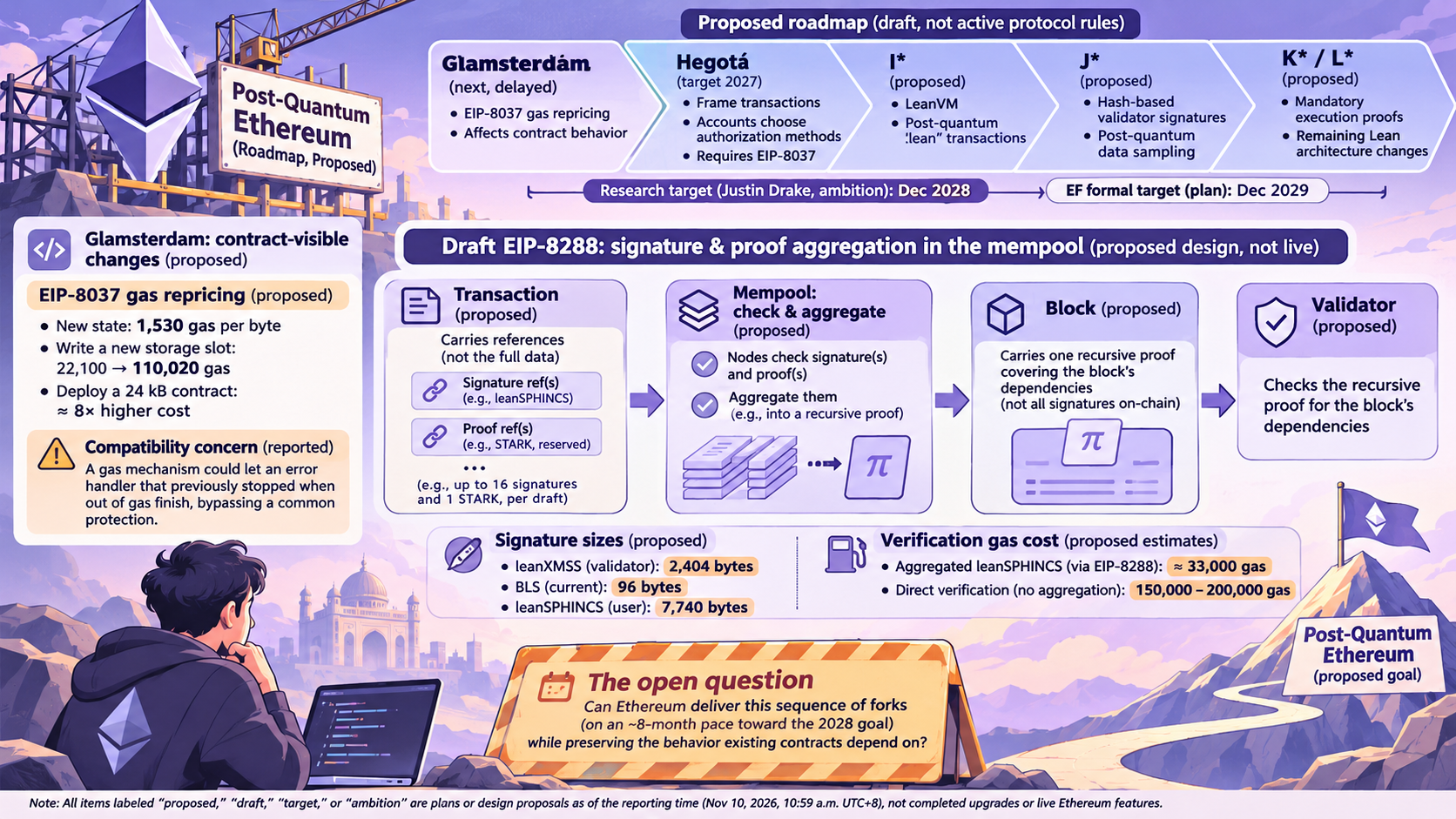
The builder-facing takeaway is a dependency, not a deployment instruction: proposed account authorization changes need compatible transaction rules, and proposed signature aggregation needs both those rules and further proof-system work. The original report’s central question remains whether Ethereum can deliver that sequence of forks while preserving the behavior existing contracts depend on.
Source: panewslab.com (originally published 2026-11-10 10:59 UTC+8)