
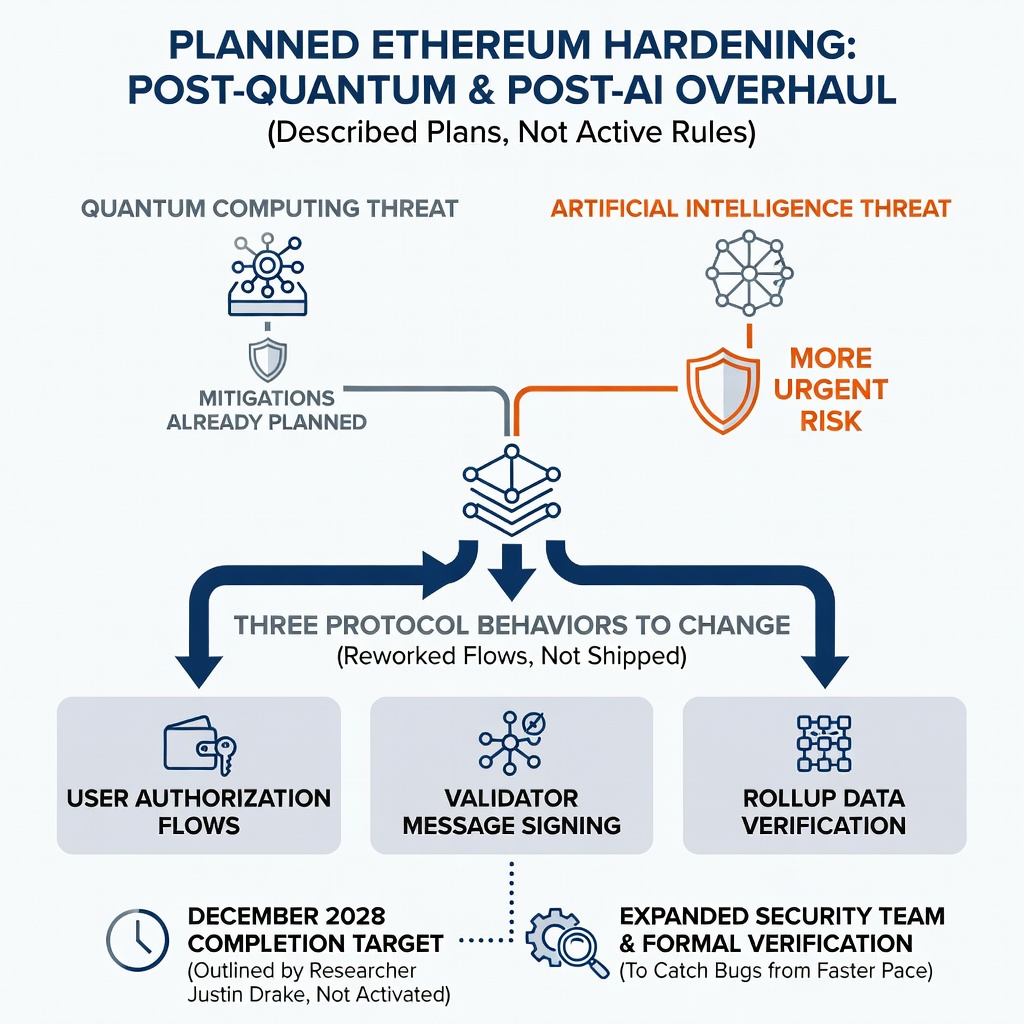
Wallet developers, validator operators, and rollup teams reading the November 24, 2026 reporting have a narrow builder task, not a shipped upgrade. A planned overhaul of how Ethereum hardens itself against quantum computers and artificial intelligence would change three behaviors: how validators sign messages, how users authorize transactions, and how Ethereum verifies data that rollups post when they settle to the network. Those are described plans. They were not reported as rules already active on mainnet.
On Monday, November 24, 2026, the Ethereum Foundation confirmed that it had doubled its protocol security team. Researcher Kev Wedderburn set out the overhaul in a blog post. Cointelegraph reported that account, and PANews reported the same core details: faster work on defenses against quantum computing and AI, and a larger security staff so review could stay alongside that pace.
Wedderburn said the coming upgrade is harder than the Merge and that the development pace required to meet it makes shipping bugs more likely. He said AI has emerged as a more urgent risk than quantum computing, while noting that Ethereum had already been planning mitigations for quantum threats. He also wrote: “Every layer of the protocol and ecosystem will need to adapt to the reality that hardening the protocol is now our highest priority.”
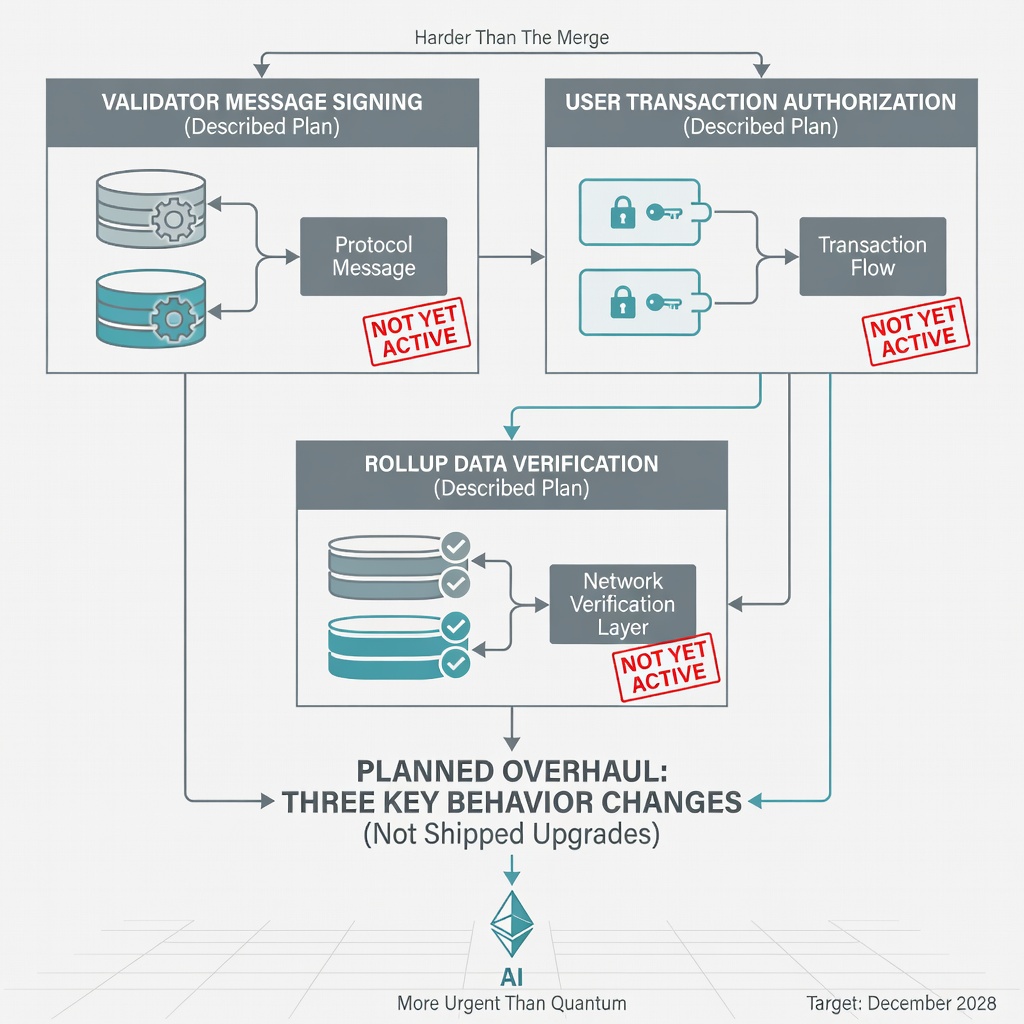
He treated the effort as a whole-layer adaptation rather than a single patch, because the three changes touch node operators, wallet software, and rollup teams that settle to Ethereum. In builder terms, that means reworking the flows a wallet uses when a user authorizes a transaction, the way a validator signs a protocol message, and the checks applied to data a rollup posts. The November 24 reporting does not name new signature schemes, transaction formats, or verification code, so those implementation details were not specified.
The staffing step is tied to speed, not to a claim that new code is already safe. Wedderburn said faster development “makes it easier to ship bugs,” and that the expanded team exists so formal verification — checking that behavior matches a written specification — and other security work can keep pace. Cointelegraph reported both statements and noted that the foundation’s next upgrade will be harder than the Merge. Doubling the team was reported as an organizational change. It is not evidence that designs have been compiled, audited, or deployed.
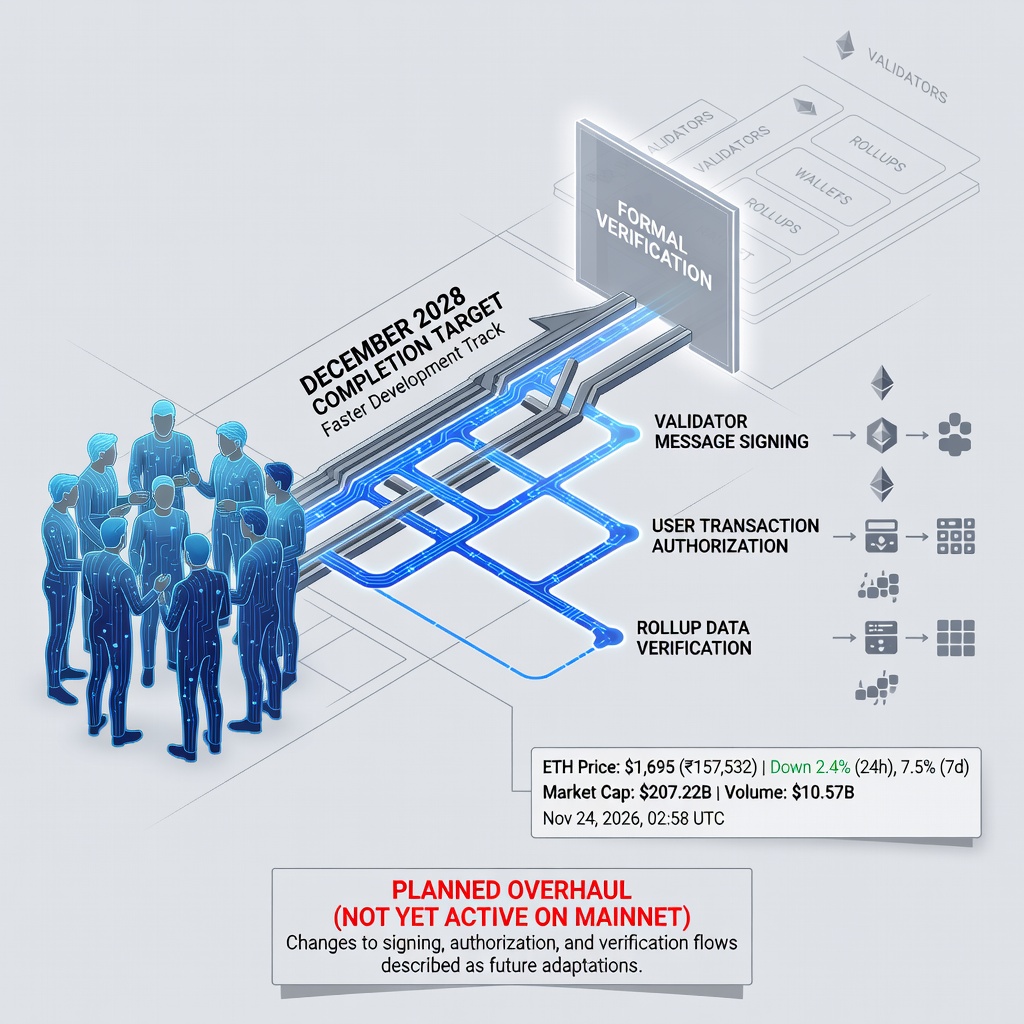
Researcher Justin Drake outlined a December 2028 target for completing the post-quantum and post-AI transition, one year earlier than the quantum-resistance deadline the foundation had previously announced, according to Cointelegraph. That is a completion target he outlined, not an activated milestone. The practical tension in Wedderburn’s account is that a faster schedule raises bug risk, so the credibility of the 2028 target depends on whether the enlarged security team can catch problems before they reach mainnet.
Separately, Cointelegraph had recently reported that Ethereum’s Glamsterdam upgrade could slip to May 2027 over compatibility concerns. That is a reported possibility about a different upgrade, not a confirmed delay of the 2028 transition, and the coverage treated it as a reminder that schedules on this network have moved before.
The same day’s market snapshot is separate from the staffing post. Ethereum traded at $1,695 (₹157,532) on November 24, 2026, according to CoinPaprika data fetched at 02:58 UTC, down 2.4% over 24 hours and 7.5% over seven days, with a market cap of $207.22 billion and 24-hour volume of $10.57 billion. Wedderburn’s post did not set a price expectation. Those figures are observed data from that timestamp, not a measured effect of the announcement.
The November 24, 2026 coverage left three checkpoints: Drake’s December 2028 completion target, whether formal verification could keep up with the three protocol surfaces, and whether Glamsterdam’s compatibility questions would show how much schedule slip the roadmap could absorb. As of that reporting, validator signing, user authorization, and rollup-data verification were still the network’s existing behavior, not the post-quantum and post-AI flows described in the blog post.