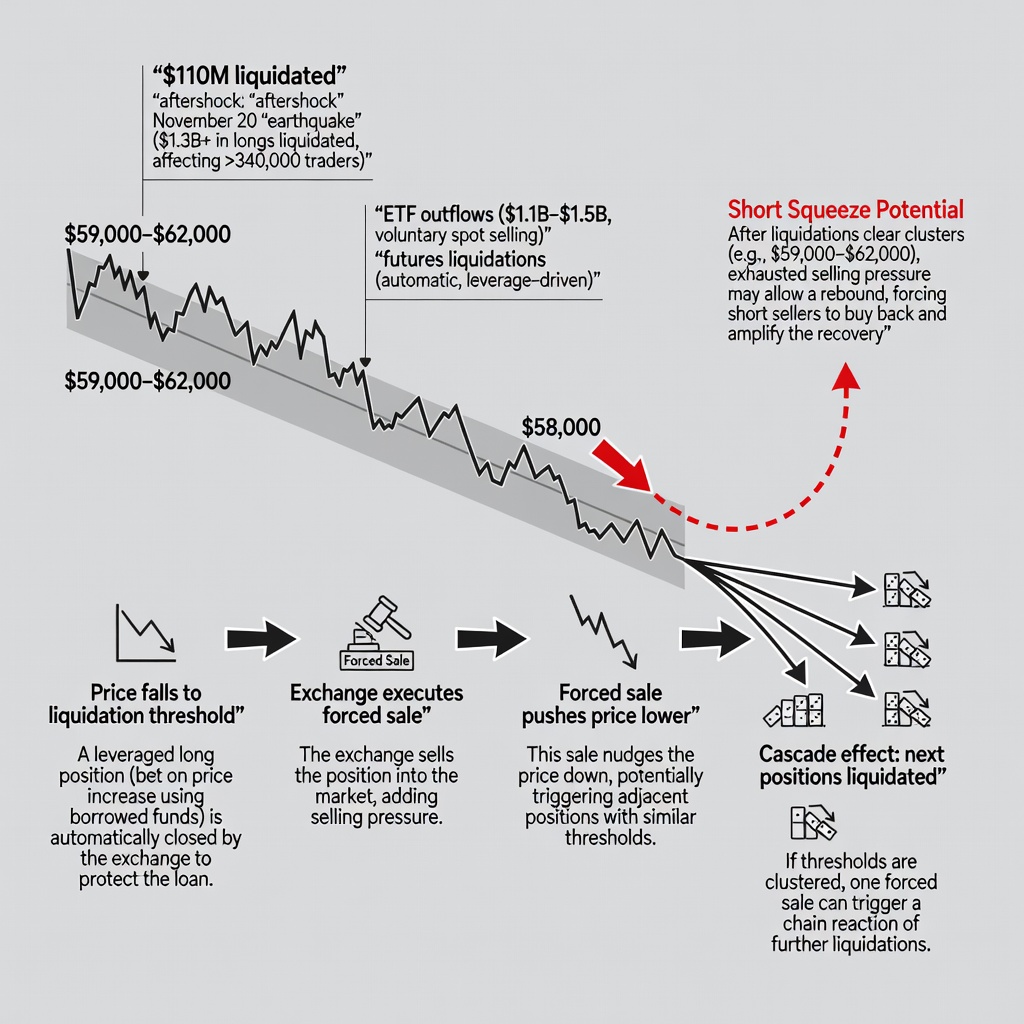
Bitcoin traded between $58,000 and $58,700 on November 25, 2026. As the price revisited $58,000, exchanges liquidated $110 million in leveraged long positions over 24 hours. That was less than a tenth of the roughly $1.3 billion in long positions liquidated across crypto futures around November 20.
A leveraged long is a bet on a price increase made partly with borrowed funds. If the price falls far enough, the exchange automatically closes the position to protect the loan. When many positions have similar liquidation thresholds, one forced sale can push the price low enough to trigger the next.
The larger November 20 swing
On November 20, Bitcoin fell to about $55,130, its lowest price since September 2024, before rebounding nearly 9% to around $60,300 in the same trading session. Estimates put total liquidations across crypto futures at $1.8 billion to $2.7 billion over 24 hours, including the roughly $1.3 billion in longs. Bitcoin futures accounted for more than $1 billion in liquidations, affecting over 340,000 traders.
Data from on-chain analytics firm Glassnode showed that the sell-off cleared a concentration of leveraged longs between $59,000 and $62,000. Once those positions had closed, they could no longer generate forced sales. That helped set the stage for a short squeeze: as the price recovered, traders who had bet on a decline were forced to buy back in, adding to the rebound.
ETF outflows were separate from forced sales
US spot Bitcoin exchange-traded funds recorded estimated net outflows of $1.1 billion to $1.5 billion during the period. Unlike futures liquidations, which exchanges trigger automatically, net ETF outflows indicate that investors reduced their exposure through the funds. The two figures describe different kinds of selling pressure, not a single liquidation total.