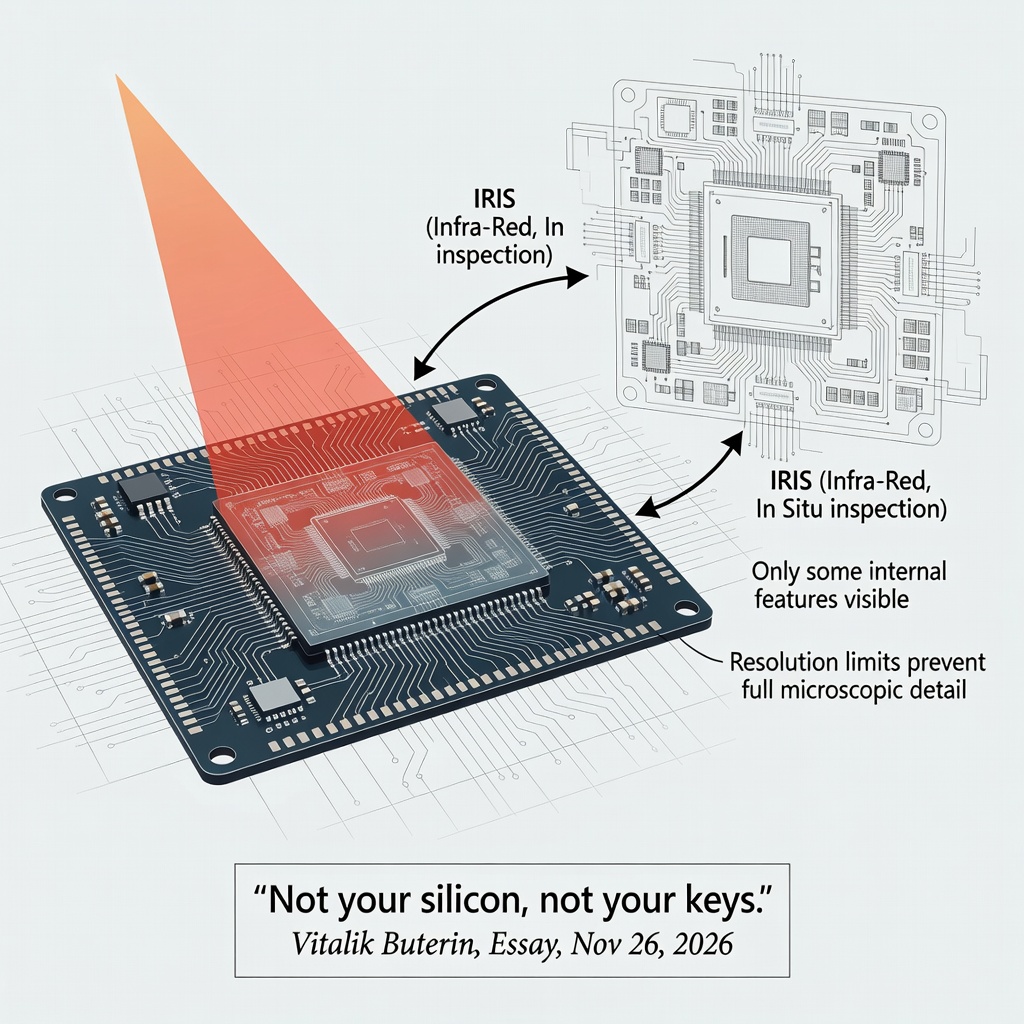
A developer reviewing a hardware wallet can read its open-source firmware to understand how the device is supposed to sign a transaction. That review cannot establish whether the chip holding the private keys matches its design. In an essay published on November 26, 2026, Ethereum co-founder Vitalik Buterin asked chipmakers to make that comparison possible: “Not your silicon, not your keys.”
When the proposal was reported on November 27, 2026, at 12:13:08 (UTC+08:00), it was a case for independent hardware inspection—not a finding that existing wallets had been compromised or a change to Ethereum’s rules.
What an inspector could check
Buterin wants manufacturers to publish GDS files, which describe a chip’s physical layout. Firmware tells a reviewer what instructions the device runs; the layout gives an inspector a reference for what should be present in the silicon. Neither file, on its own, proves what a manufacturer shipped.
One way to examine the physical device comes from hardware security researcher Andrew “bunnie” Huang. His technique, Infra-Red, In Situ inspection (IRIS), takes advantage of silicon’s transparency at certain infrared wavelengths. With suitable illumination and imaging equipment, an inspector can see parts of a chip’s internal structure without necessarily removing it from the circuit board. Comparing those features with the intended layout could reveal a substituted component or an unexpected difference.
A matching image would not settle every question. As Huang explained in a 2024 research update, infrared imaging cannot reliably resolve every microscopic feature of a modern chip. Electrical tests could complement the images. Buterin expects specialist organizations, rather than individual wallet owners, to undertake this kind of inspection.
There are trade-offs for manufacturers, too. Chipmakers invest in proprietary processes, and designing a component for inspection can cost performance. A wallet that signs transactions, however, does not need the computing power of a modern AI processor. That makes signing devices a plausible place to try the approach.
How the proposal fits Buterin’s work
Buterin’s November 2013 draft of the Ethereum whitepaper addressed a different builder’s problem: how to run an application without creating a blockchain for it. A lending developer, for example, could express collateral and withdrawal rules in a smart contract and have Ethereum execute them. Making those rules readable does not prove they are free of bugs. Buterin draws a similar distinction for wallets: publishing a design makes scrutiny possible, but it does not establish that a particular device is secure.
A Russian-Canadian programmer born in 1994, Buterin discovered Bitcoin in 2011 and co-founded Bitcoin Magazine. He was 19 when he conceived Ethereum. According to the University of Waterloo, where he studied computer science and worked as a research assistant to cryptographer Ian Goldberg, he received a $100,000 Thiel Fellowship in 2014 and left to work on Ethereum full-time.
Seven other co-founders helped build the project: Gavin Wood, Joseph Lubin, Charles Hoskinson, Anthony Di Iorio, Mihai Alisie, Jeffrey Wilcke and Amir Chetrit. Ethereum’s first live network, Frontier, launched on July 30, 2015. Its shared programming environment went on to support stablecoins, exchanges and lending protocols.
Buterin returned to the question of what users can verify in his September 2025 essay The Importance of Full-Stack Openness and Verifiability, which considered both software and the hardware beneath it. His influence does not give him unilateral authority over Ethereum. In April 2025, the Ethereum Foundation described his role as providing technical and intellectual guidance. Network changes still require discussion, software development and adoption by participants. The wallet proposal asks something of chip manufacturers, not Ethereum validators.
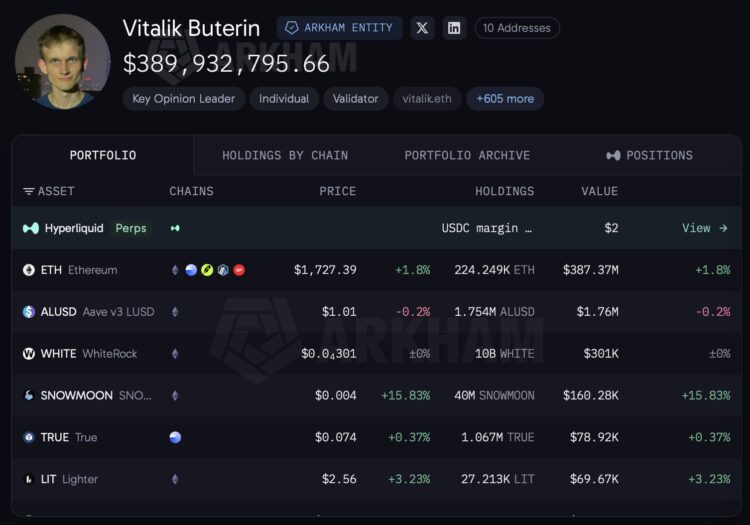
Buterin’s public holdings are likewise distinct from control of the network. Arkham Intelligence attributed $389.9 million in tracked assets to him, including 224,249 ETH. That wallet snapshot is not a measure of his net worth: it does not establish his liabilities, private assets or holdings at unidentified addresses.