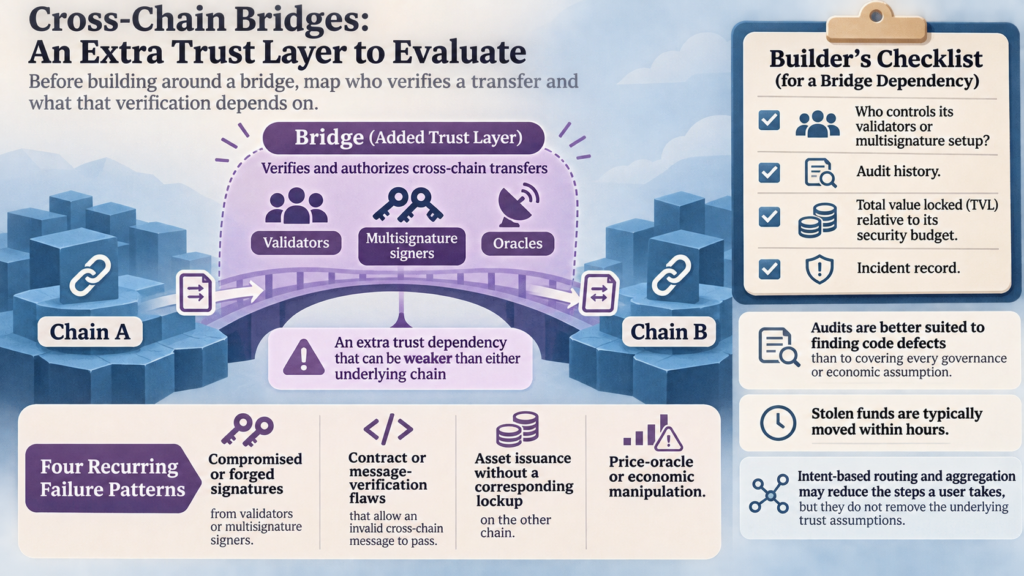
Before building around a cross-chain bridge, map who verifies a transfer and what that verification depends on. In a report published on 17 November 2026, the author argues that bridges add a trust layer—such as validators, a multisignature group or an oracle—above the chains they connect. That added layer can be weaker than either underlying chain.
The report groups recurring failures into four patterns:
- Compromised or forged signatures from validators or multisignature signers.
- Contract or message-verification flaws that allow an invalid cross-chain message to pass.
- Asset issuance without a corresponding lockup on the other chain.
- Price-oracle or economic manipulation.
The author cautions that audits are better suited to finding code defects than to covering every governance or economic assumption. The report also says stolen funds are typically moved within hours.
For a builder assessing a bridge dependency, the practical checklist is to examine who controls its validators or multisignature setup, its audit history, its total value locked (TVL) relative to its security budget, and its incident record. Intent-based routing and aggregation may reduce the steps a user takes, but, as the report notes, they do not remove the underlying trust assumptions.