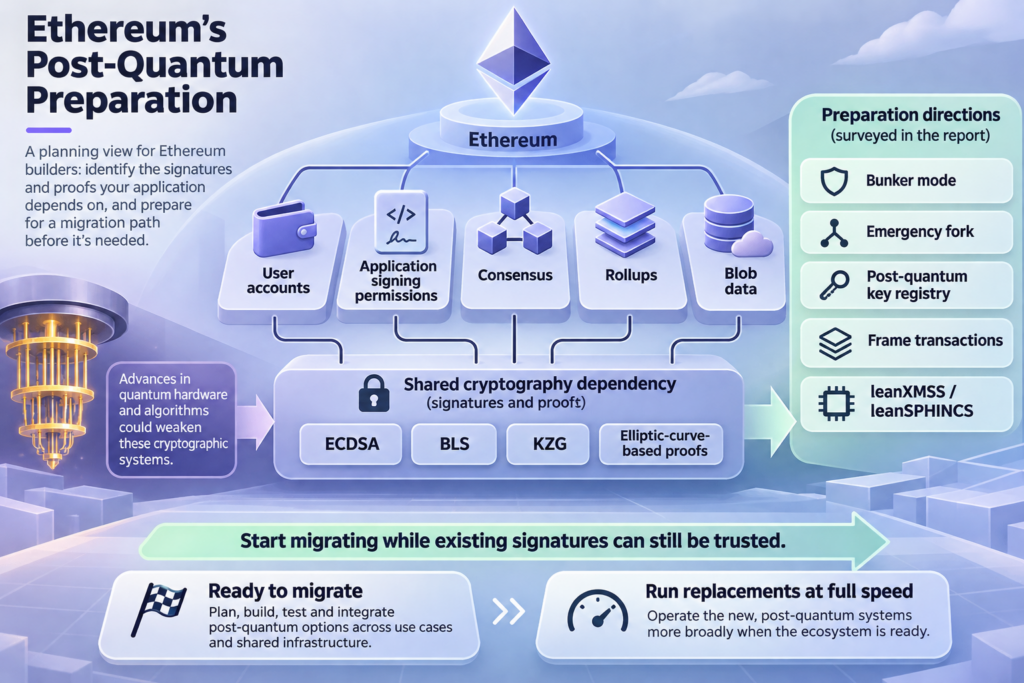
For Ethereum builders, the practical post-quantum question is which signatures and proofs an application depends on—and whether they can be replaced while the current ones are still trusted.
A report published on November 18, 2026, at 12:26 p.m. UTC+8, describes how advances in quantum hardware and algorithms could weaken ECDSA, BLS, KZG and elliptic-curve-based proof systems. The potential effects extend beyond user accounts to application signing permissions, consensus, rollups and blob data. These are risks to prepare for, not failures the report says have occurred.
Citing an estimate from Project Eleven, the report says roughly 88 million ETH—about 72%—could be exposed. That figure is an estimate of potential exposure, not a confirmed loss. The report also points to risks in infrastructure shared across applications.
The responses it surveys include a proposed “bunker mode,” an emergency fork, a post-quantum key registry, frame transactions, and leanXMSS and leanSPHINCS. It presents these as directions for preparation, not as changes already in force. Its central distinction is between being ready to migrate and running the replacement systems at full speed: migration must begin while existing signatures can still be trusted.