
Developers who set fixed gas limits for contract deployments or bridge transactions may need to review them before Ethereum’s planned Glamsterdam upgrade. As reported on November 16, 2026, Vitalik Buterin backed EIP-8037, a proposal—not an enacted rule—that would increase the gas charged for creating accounts, storage slots and contract code.
Gas measures the resources charged for an Ethereum operation. Buterin’s argument is that Ethereum can expand transaction execution faster than it can expand state: the persistent data that network nodes must store. He said raising the cost of creating state would let execution capacity grow without placing the same rate of growth on node storage.
In Buterin’s examples, the proposal would change gas charges as follows:
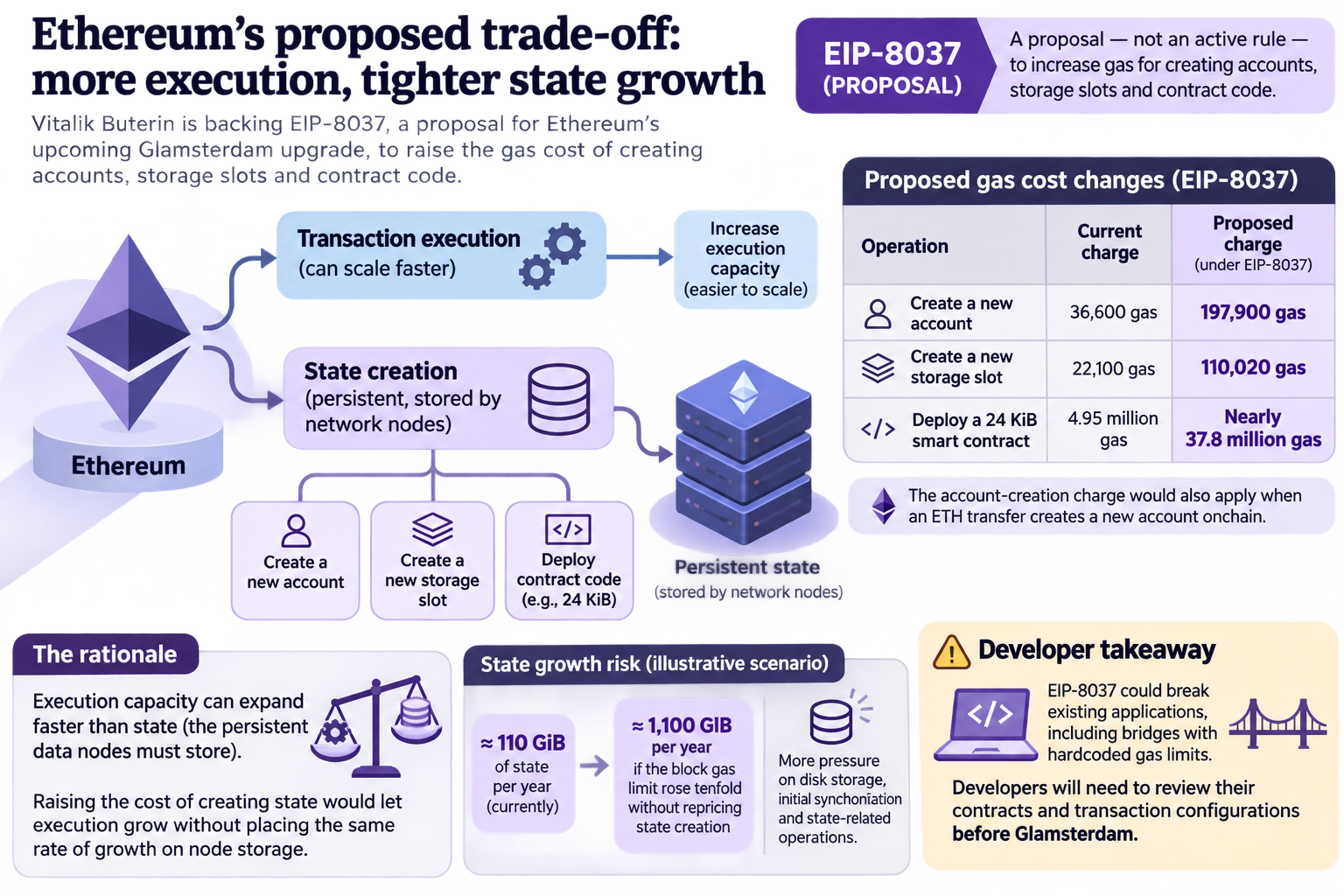
| Operation | Current charge | Proposed charge |
|---|---|---|
| Create a new account | 36,600 gas | 197,900 gas |
| Create a new storage slot | 22,100 gas | 110,020 gas |
| Deploy a 24 KiB smart contract | 4.95 million gas | Nearly 37.8 million gas |
The proposed account-creation charge would also apply when an ETH transfer creates a new account onchain. Buterin estimated that Ethereum currently adds about 110 GiB of state per year. In his illustrative scenario, raising the block gas limit tenfold without repricing state creation would bring that figure to 1,100 GiB annually, increasing pressure on disk storage, initial synchronization and state-related operations.
Buterin acknowledged that EIP-8037 could break existing applications, including bridges with hardcoded gas limits. He said developers would need to review contracts and transaction configurations before Glamsterdam. The figures describe a proposal under discussion, not gas charges already in effect.