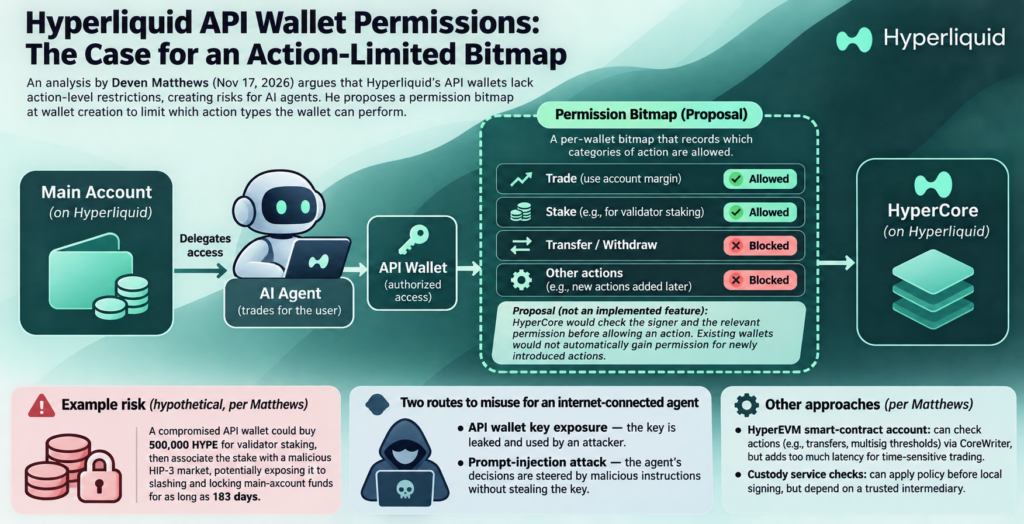
An AI agent that trades for a user needs permission to act—but not necessarily permission to perform every action available to the user’s account. In an analysis published on November 17, 2026, Deven Matthews argued that Hyperliquid’s API wallets lack the action-level restrictions needed to make that distinction reliably.
The risk Matthews identifies
API wallets were originally restricted from withdrawing directly from a main account or transferring funds to an external address, Matthews wrote. But he argued that their ability to use account margin was not capped, leaving a compromised wallet capable of moving value through trades. He also said subsequent network upgrades expanded the actions API wallets could perform without giving users a way to restrict those actions individually.
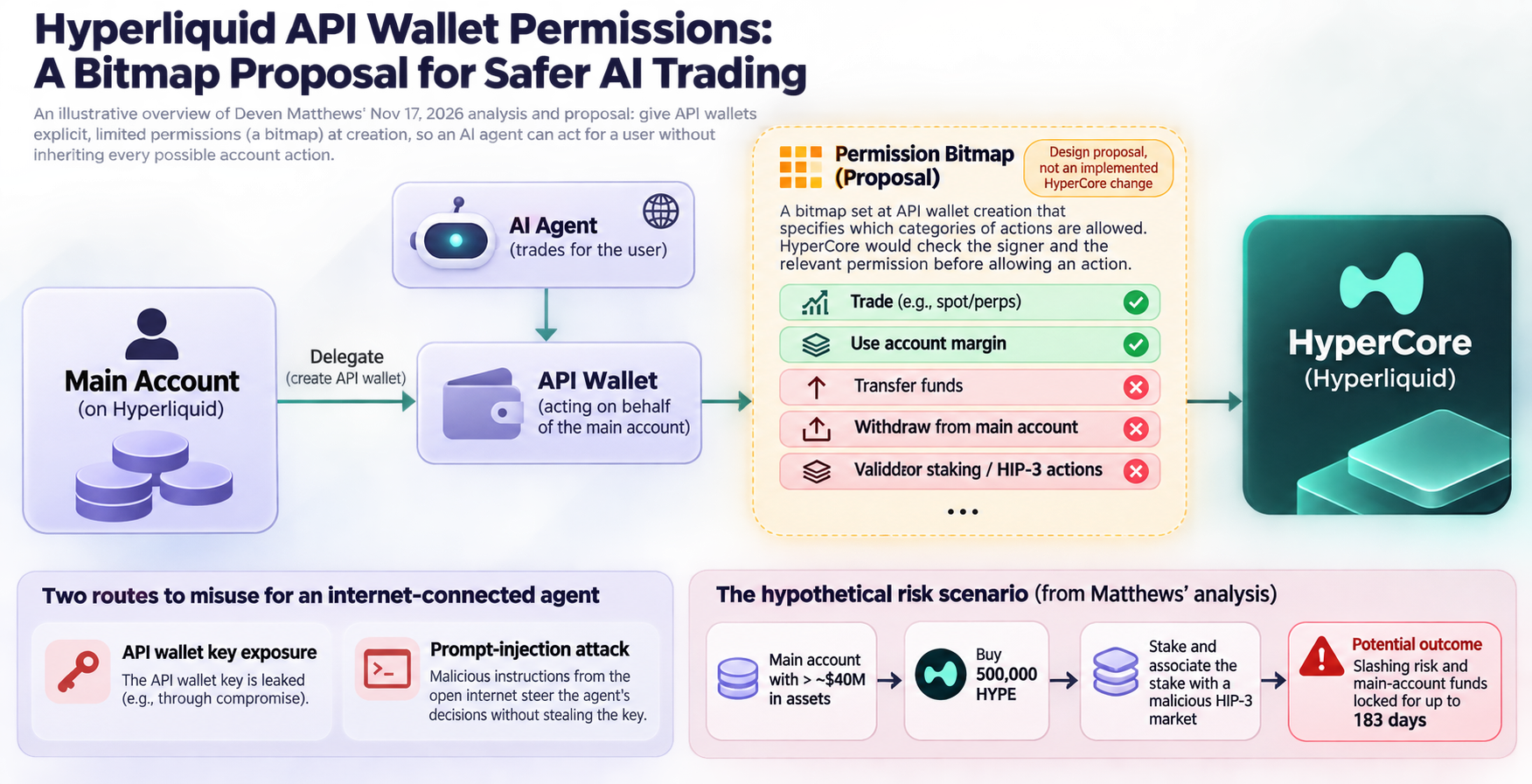
Matthews described a hypothetical case involving a main account with more than approximately $40 million in assets: a maliciously controlled API wallet could buy 500,000 HYPE for validator staking, then associate the stake with a malicious HIP-3 market. In his account, that could expose the stake to slashing and lock main-account funds for as long as 183 days. This is a scenario presented by the author, not a reported incident.
For an agent that reads information from the open internet, Matthews identified two routes to misuse: exposure of its API wallet key, or a prompt-injection attack that steers the agent’s decisions without stealing the key.
The proposed permission check
Matthews said developers can use a HyperEVM smart-contract account to check actions such as transfers and multisignature thresholds before interacting with HyperCore through CoreWriter. He argued that this path adds too much latency for time-sensitive trading, while checks applied by a custody service before local signing depend on that intermediary.
His proposed alternative is a permission bitmap added when an API wallet is created. A bitmap records which categories of action that wallet may perform; HyperCore would check the signer and the relevant permission before allowing an action. Matthews pointed to the HIP-3 sub-deployer mechanism as a precedent for limited permissions. Crucially, under his proposal, an existing API wallet would not automatically gain permission for a newly introduced action.
This is a design proposal, not an announced HyperCore change. It addresses which types of action an agent can take; the article does not present the bitmap as a complete solution for limits such as per-market access or margin caps.