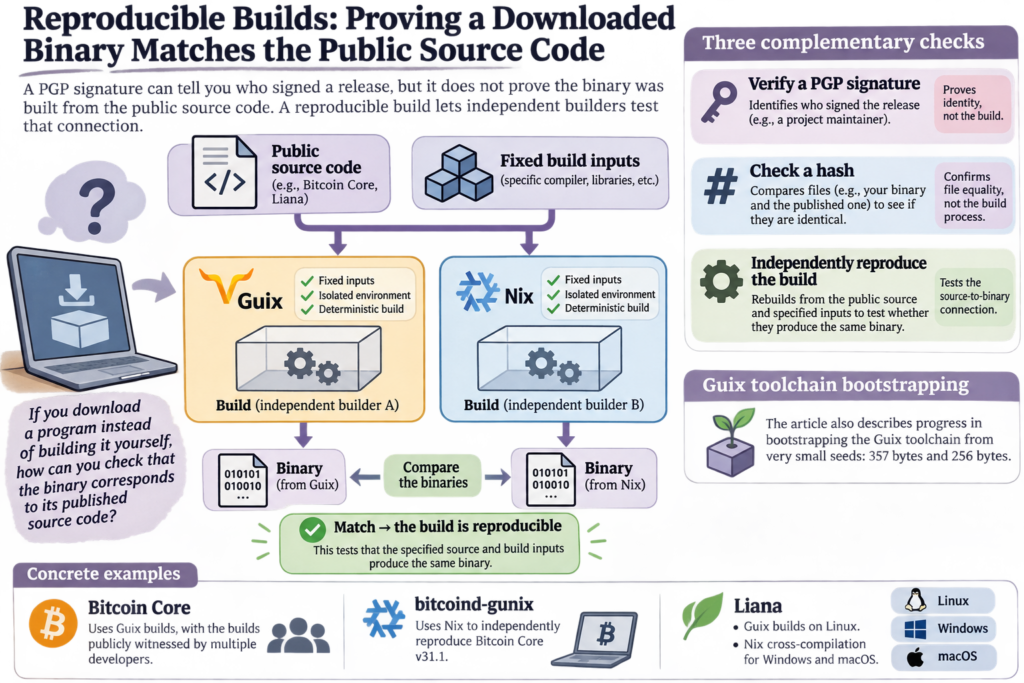
If you download a program instead of building it yourself, how can you check that the binary corresponds to its published source code? An article published on November 13, 2026 explains why a PGP signature alone cannot answer that question: it can identify who signed a release, but it does not establish that the binary was built from the public code.
A reproducible build gives independent builders a way to test that connection. The article describes how Guix and Nix fix build inputs, isolate the build environment and aim for deterministic output. It also discusses progress in bootstrapping the Guix toolchain from 357- and 256-byte seeds.
The examples are concrete. Bitcoin Core uses Guix builds witnessed publicly by multiple developers, while bitcoind-gunix uses Nix to reproduce Bitcoin Core v31.1 independently. For Liana, the article describes Guix builds on Linux and Nix cross-compilation for Windows and macOS.
The article also covers checking signatures and hashes and reproducing Bitcoin Core and Liana builds. Those are distinct checks: verifying a signature identifies a signer, and checking a hash compares files; independently reproducing a build tests whether the specified source and build inputs produce the same binary. The supplied account of the article does not include its commands, so no command sequence is reproduced here.