
In a November 23, 2026 advisory, Commodity Futures Trading Commission (CFTC) staff said they would not object to US futures exchanges and derivatives clearinghouses counting Bitcoin, Ether and qualifying payment stablecoins toward a year of projected operating costs after discounting their market value. None of those assets counts toward the separate six-month liquidity requirement.
When the guidance was reported on November 25, 2026, at 10:50:52 UTC+8, existing rules remained in force. Staff Advisory 26-31 sets out a valuation approach, not a rule change, and gives firms no assurance that staff will decline to recommend enforcement.
Two tests for operating resources
Designated contract markets and derivatives clearing organizations must hold enough resources to cover at least one year of projected operating costs on a rolling basis. Within that pool, they must have enough unencumbered cash or highly liquid securities to cover at least six months of expenses. Under certain conditions, a committed credit line or similar facility can cover a liquidity shortfall.
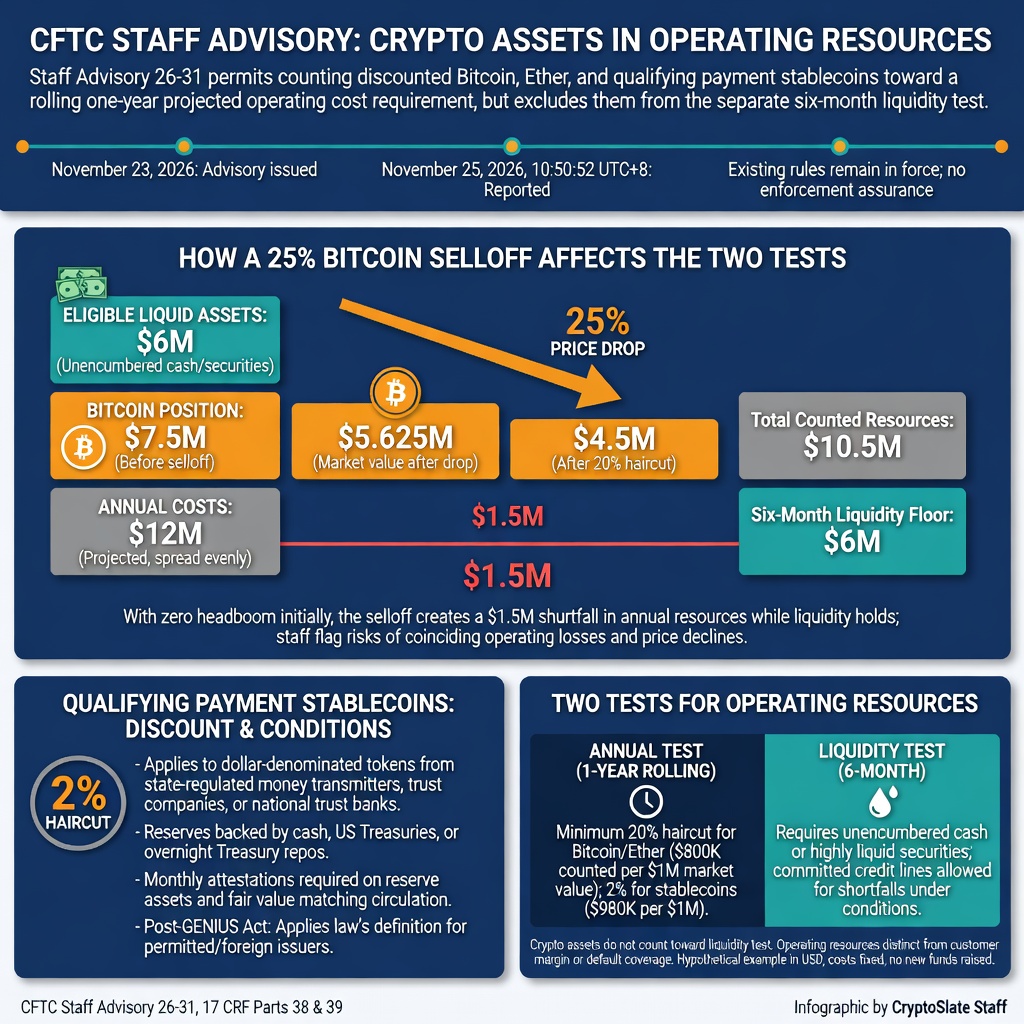
For the annual test, staff specify a minimum valuation discount, or haircut, of 20% for Bitcoin and Ether and a 2% discount for qualifying payment stablecoins. At those rates, a firm can count $800,000 for every $1 million it holds in Bitcoin or Ether, compared with $980,000 for the same market value in qualifying stablecoins. The discount applies to current market value, not the price the firm paid.

How a Bitcoin decline affects the two tests
Consider a hypothetical exchange with $12 million in projected annual costs, spread evenly through the year. It holds $6 million in eligible liquid assets and $7.5 million in Bitcoin. At a fixed 20% haircut, the Bitcoin counts for $6 million. The exchange meets both tests exactly.
If Bitcoin falls 25%, the position is worth $5.625 million and counts for $4.5 million after the haircut. With costs unchanged and no new funds, the exchange now has $10.5 million in counted resources, $1.5 million short of its annual requirement. Its $6 million in liquid assets still covers six months of expenses. Staff also flagged the risk that operating losses and falling crypto prices could coincide, reducing the value of reserves just when a firm needs them.
Which payment stablecoins qualify?
Before the GENIUS Act takes effect, staff limit the 2% treatment to dollar-denominated tokens issued by a state-regulated money transmitter or trust company, or by a national trust bank. The issuer must back the tokens, directly or indirectly, with reserves limited to cash, US Treasuries or overnight Treasury repurchase agreements. Monthly attestations must identify the reserve assets and address whether their fair value matches the amount of tokens in circulation.
Once the Act takes effect, the advisory uses the law’s definition of a payment stablecoin. The issuer must be a permitted issuer or a foreign issuer that meets the law’s applicable conditions.
Operating resources are distinct from customer margin posted against trading positions. A clearinghouse also cannot count the same assets toward both operating costs and coverage for clearing-member defaults. The CFTC’s November 13 registration order for Backpack Clearing, formerly TLD Clearing Inc., permits it to clear margined futures as well as fully collateralized futures, options on futures and swaps. The registration records do not disclose what it holds for operating costs or whether it uses the staff guidance.