When building an asset that can be traded in fractions but also represented by individual NFTs, the central contract-design task is keeping those two views in sync. This November 20, 2026 architectural retrospective compares ERC-404’s early single-contract approach with DN-404’s separate token and NFT contracts. It describes design trade-offs, not measured adoption or market impact.
The shared-balance approach
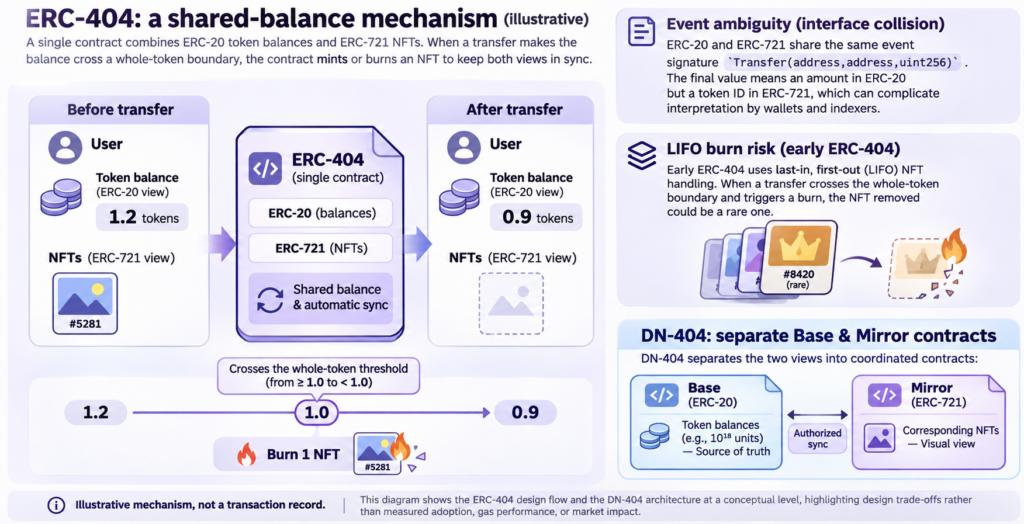
ERC-20 represents interchangeable token amounts; ERC-721 represents individually identified NFTs. The Pandora team’s early-2024 ERC-404 design brought both behaviors into one contract. In the mechanism described here, reaching a whole-token balance triggers an NFT mint. Falling below a whole-token threshold—for example, from 1.2 tokens to 0.9—triggers an NFT burn.
That coupling creates several engineering concerns. Both standards use a Transfer(address,address,uint256) event signature, but its final value means an amount in ERC-20 and a token ID in ERC-721. Combining the behaviors can therefore complicate interpretation by wallets and indexers. A transfer that crosses a whole-token threshold also requires NFT state changes, adding gas-consuming work beyond an ordinary ERC-20 transfer.
The source also describes a risk in early ERC-404’s last-in, first-out NFT handling: when a transfer causes an NFT to be burned, the NFT selected could be a rare one. The trigger is crossing the relevant whole-token boundary, not every fractional sale.
DN-404 separates the two views
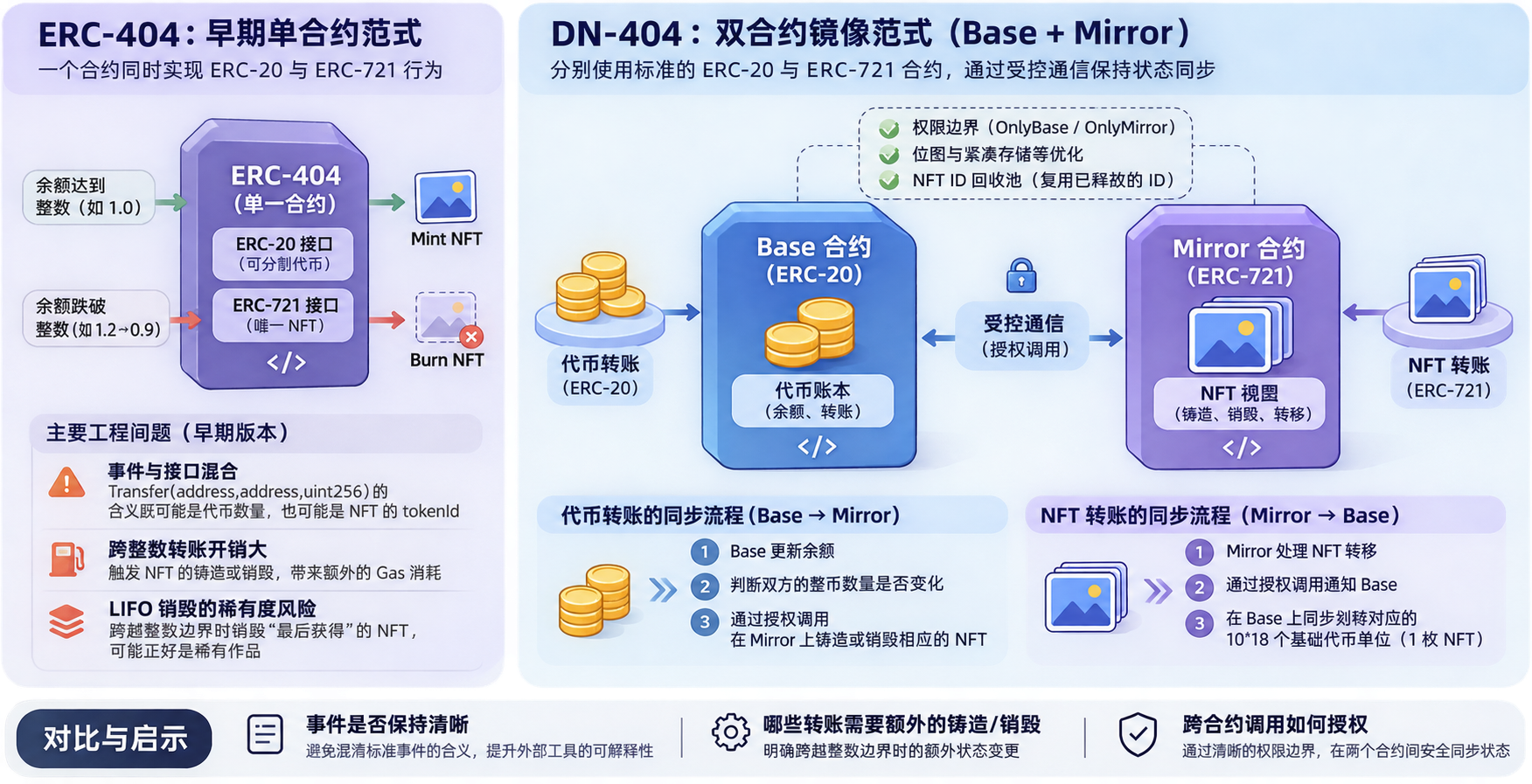
DN-404, introduced by Vectorized and other developers, instead uses a Base ERC-20 contract for token balances and a Mirror ERC-721 contract for the corresponding NFTs. The contracts are separate but coordinate their state.
In the described flow, a Base-token transfer updates balances and determines whether either party’s whole-token count changed. Authorized communication with Mirror then adjusts the corresponding NFTs. An NFT transfer takes the reverse path: Mirror communicates with Base so the associated token units move as well. The source describes one NFT transfer as corresponding to 10^18 base-token units.
Separating the interfaces is intended to make each side easier for existing ERC-20 or ERC-721 tools to interpret. The source also describes permission boundaries between the contracts, bitmap and compact-storage optimizations, and a pool that reuses NFT IDs. Those are architectural features and stated efficiency aims; the article supplies no benchmark establishing a particular gas saving or proof of universal compatibility.
What changed—and what builders can take from it
ERC-404 later received a v2 update that, according to the source, added optimizations including a token-ID recycling pool and changes to event encoding. It remains a different architectural route from DN-404’s Base-and-Mirror design.
For a Solidity builder, the comparison highlights three questions: Will standard events remain unambiguous to external tools? Which transfers require additional mint or burn work? And how are cross-contract calls authorized when token and NFT state must change together? The designs answer those questions differently; neither the retrospective nor its architectural comparison establishes how any particular deployment performs in production.