
For builders considering native BTC as loan collateral, Babylon’s proposed change would replace its staking-focused model with Trustless Bitcoin Vaults (TBV). As reported on November 20, 2026, this was a governance proposal, not an enacted shutdown or a live lending integration.
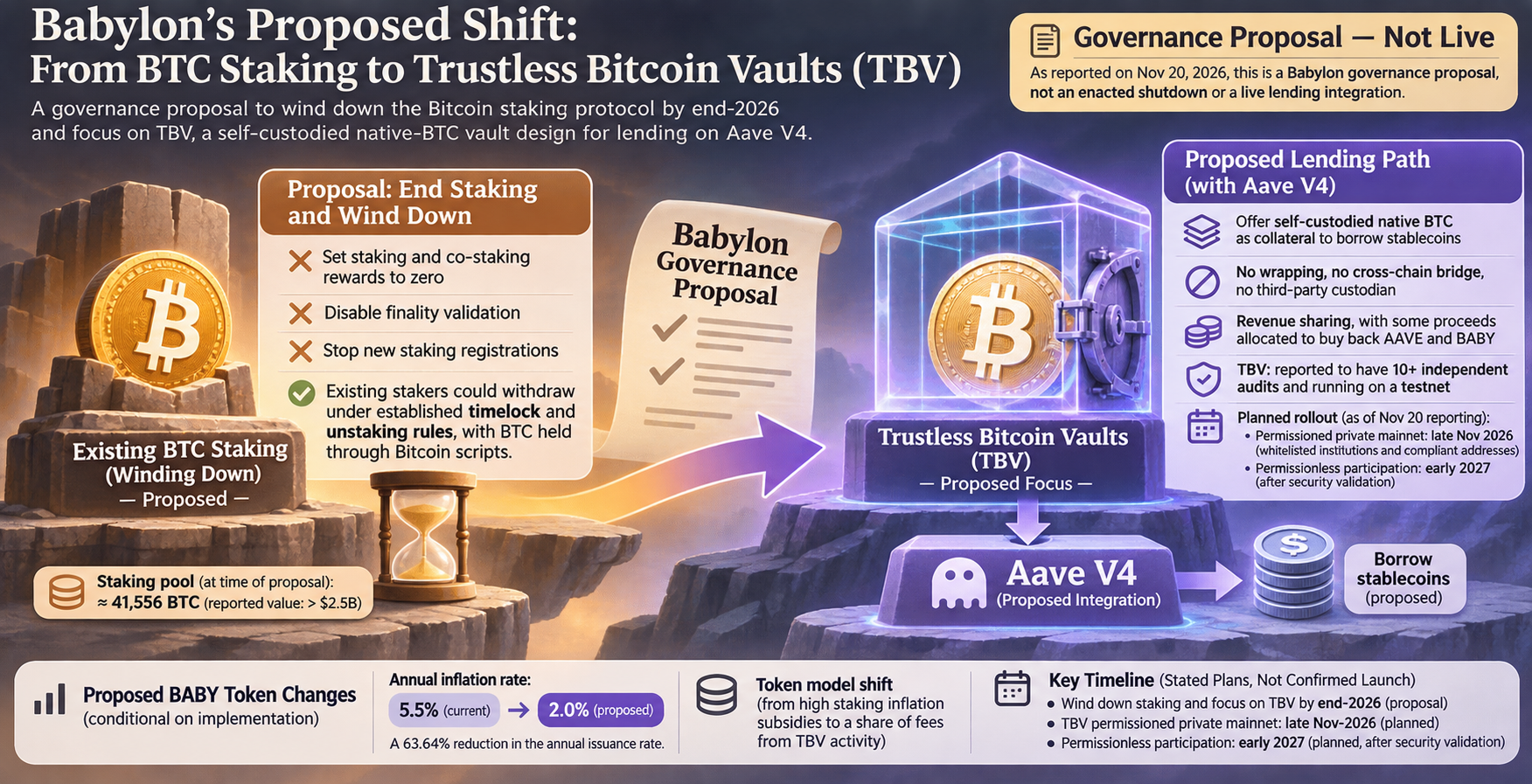
Babylon co-founder Fisher Yu proposed on the project’s governance forum that the community wind down its Bitcoin staking protocol before the end of 2026 and concentrate on TBV. At the time of the proposal, the staking pool held approximately 41,556 BTC, valued in the report at more than $2.5 billion.
What would change for stakers
The proposal calls for setting staking and co-staking rewards to zero, disabling finality validation and stopping new staking registrations. It says existing stakers could withdraw under the established timelock and unstaking rules, with their BTC held through Bitcoin scripts. Claims that the transition would involve no principal loss or unilateral transfers are part of the proposal, not demonstrated outcomes.
The plan would also cut BABY’s annual inflation rate from 5.5% to 2.0%—a 63.64% reduction in the annual issuance rate—and shift the token model toward a share of fees from TBV activity. Those changes depend on the proposal being implemented.
The proposed lending path
The November 20 report said an Aave governance-forum vote on November 9 approved an ARFC-stage proposal concerning TBV and Aave V4, with 100% voting in favor. The envisioned integration would let users offer self-custodied native BTC as collateral to borrow stablecoins without first wrapping the BTC, using a cross-chain bridge or placing it with a third-party custodian. The reported plan also includes revenue sharing and allocating some proceeds to buy back AAVE and BABY. The forum vote should not be read as confirmation that borrowing was already available.
According to the report’s account of Babylon Labs’ portal, TBV had undergone audits by more than 10 independent security teams and was running on a testnet. A permissioned private mainnet was expected in late November 2026, initially for whitelisted institutions and compliant addresses, with permissionless participation planned for early 2027 after security validation. Those were stated plans and assessments as of the original November 20 reporting date, not confirmed launch outcomes.